
Red alert: 7 corporate cybersecurity threats that need immediate mitigation

The July 2026 report from Cybersecurity Insiders published the 7 most urgent corporate cybersecurity threats, including: Ransomware, Phishing & BEC, Cloud Security, Supply Chain Attacks, Insider Threats, Artificial Intelligence, and IoT Devices. Applying a Zero Trust architecture, multi-factor authentication (MFA), and continuous monitoring is vital to prevent data leaks.
Just one wrong click, and your entire core data system could evaporate overnight. Did you know that 34% of enterprises in Vietnam are currently directly affected by supply chain attacks through vulnerabilities from third-party partners? If you still maintain a defense mindset using legacy firewalls, your business has almost no chance of surviving against today's AI-automated intrusion campaigns. Do not let your intellectual property be encrypted and publicly extorted. Apply expert defense strategies immediately to seal the 7 critical vulnerabilities below.
What are the 7 most dangerous corporate cybersecurity threats today?
According to Cybersecurity Insiders, the 7 most urgent corporate cybersecurity threats span across human factors, supply chains, and technology infrastructure. Accurately identifying these risks is the first step to help businesses build a proactive defense strategy.

The detailed list of the 7 core threats includes:
Ransomware: Cybercriminals apply double extortion tactics, extracting sensitive data to threaten public disclosure before locking systems, heavily targeting healthcare, finance, and manufacturing.
Phishing & BEC (Business Email Compromise): Fake invoices or highly convincing executive impersonation emails are crafted to steal identities.
Cloud Security: Data exposure risks arise due to misconfigured storage services and weak API access controls.
Supply Chain Attacks: Adversaries compromise software vendors or managed service providers (MSPs) to indirectly infiltrate organizations.
Insider Threats: Data loss caused by negligent users, compromised privileged accounts, or malicious behavior from within.
Artificial Intelligence: AI is abused to automate reconnaissance, write stealthy malware, and launch large-scale phishing campaigns.
IoT Devices: Security cameras, printers, and sensors using outdated firmware become entry points for hackers to infiltrate internal networks.
The Cybersecurity Insiders report confirms the 7 most dangerous corporate cybersecurity threats include Ransomware, Phishing, Cloud Security, Supply Chain Attacks, Insider Threats, Artificial Intelligence, and IoT Devices. The shift to the cloud makes these risks increasingly devastating.
Why do APT groups prioritize exploiting Supply Chain Attacks in Vietnam?
Supply chain attacks allow hackers to infiltrate a mass of targets by compromising a single software vendor. In Vietnam, this method is actively used by APT groups to target critical infrastructure sectors.
Instead of directly attacking heavily guarded firewalls, adversaries target highly trusted third parties. Notorious cyber espionage groups like Mustang Panda, APT32, and Lotus Blossom are strategically targeting critical sectors in Vietnam such as telecommunications, military, healthcare, and public service infrastructure. Notably, they are exploiting gaps from third-party partners to execute supply chain attacks - a risk currently directly affecting 34% of domestic enterprises. The primary intrusion tactic is distributing malicious files (.lnk, .chm) via spoofed emails to implant PlugX malware, thereby controlling devices remotely and even manipulating familiar messaging applications like Zalo and Viber.
Did you know: The first quarter of 2026 marked a period of significant increases in many cybersecurity indicators in Vietnam. According to published statistics, the country recorded 165 data breaches, over 473 million records leaked, 6.9 million login credentials detected online, and 3,890 active fake domains. See details in the article Cybersecurity in Vietnam Q1/2026: Data becomes the primary target for cybercriminals
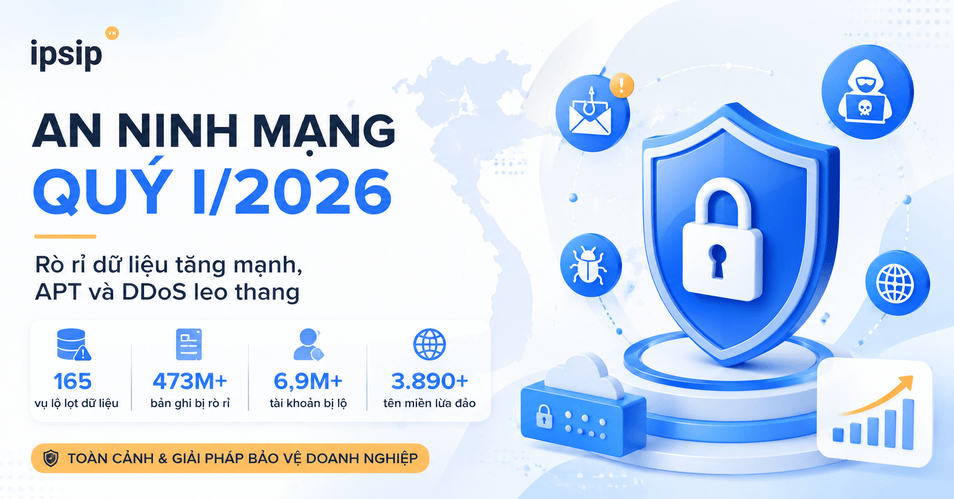
Supply Chain Attacks are being abused by APT groups like Mustang Panda and APT32 to infiltrate Vietnam's telecommunications and healthcare infrastructure. This third-party risk currently directly affects 34% of domestic enterprises through PlugX malware.
What are the root causes making Cloud Security and IoT Devices vulnerable?
Cloud Security and IoT Devices are vulnerable due to weak access controls, misconfigured settings, and neglected firmware updates. The expanding attack surface renders traditional internal network firewalls ineffective.
The rapid shift to AWS, Microsoft Azure, or Google Cloud environments demands a new security mindset. When businesses skip operating system security optimization (OS Security) and Secure System Deployment, vulnerabilities from peripheral devices connect straight to the core data center.
Attack Surface | Core Risk Cause | Potential Consequence |
Cloud Security | Misconfigured storage, lack of strict Identity and Access Management (IAM). | Leaking millions of customer data records, severely violating international legal regulations. |
IoT Devices | Devices running outdated firmware, keeping default manufacturer passwords (admin/admin). | Being exploited as pivot points (botnets) to stealthily infiltrate core server systems. |
Cloud Security and IoT Devices become critical weaknesses due to misconfigured storage services and devices using outdated firmware. Millions of data records can be leaked if organizations lack strict Identity and Access Management (IAM) policies and network segmentation.
How does Artificial Intelligence impact Phishing and Ransomware?
Artificial Intelligence is a double-edged sword, abused by cybercriminals to automate the creation of realistic Phishing emails and accelerate Ransomware development. It breaks down human defense barriers because it operates at machine speed.
Accelerated Reconnaissance: AI analyzes massive amounts of open-source data to automatically find configuration weaknesses in target enterprises.
Social Engineering: Generative AI perfectly mimics the writing style of C-level executives, creating Business Email Compromise (BEC) scenarios that are nearly impossible to detect by the naked eye.
Bypassing Defenses: AI automates the creation of ransomware malware, generating stealthy variants that evade traditional detection tools.
In early July 2026, the world witnessed a ransomware attack – JADEPUFFER – which was 100% AI-powered, executing the entire attack chain from start to finish without any human intervention.
Artificial Intelligence is being abused by criminals to automate Ransomware development and create highly realistic Phishing campaigns. This combination breaks all manual defense barriers, requiring organizations to apply commensurate protective technology.
What infrastructure checklist must businesses implement immediately for defense?
Businesses must shift to a Zero Trust architecture, strictly control identities, and optimize Cyber Resilience. Below are the urgent actions that must be executed.
[ ] Deploy multi-factor authentication (MFA) mandatorily for 100% of system accounts.
[ ] Establish a Zero Trust model, requiring continuous verification for every device, even inside the network.
[ ] Apply the principle of least privilege to prevent Insider Threats.
[ ] Launch routine Patch Management processes for operating systems and IoT devices.
[ ] Build an offline data Backup strategy to neutralize the extortion capabilities of Ransomware.
To counter the 7 modern cyber threats, businesses must mandatorily deploy multi-factor authentication (MFA) and apply a Zero Trust architecture for the entire system. Continuous patch management and offline data backups are vital keys to maintaining business operations.
How to control security risks for supply chain partners?
Controlling Supply Chain Attacks requires businesses to continuously conduct Vendor Risk Assessments and strictly monitor third-party access privileges. Absolute trust in software updates is extremely risky.
[ ] Require all MSP partners to provide periodic independent security assessment reports.
[ ] Conduct Software Integrity Verification for all updates before deploying them into the production environment.
[ ] Implement Network Segmentation to strictly limit the scope of resources that vendors can access.
[ ] Include mandatory cybersecurity compliance and auditing clauses in service level agreements (SLAs).
Preventing Supply Chain Attacks requires businesses to continuously monitor third-party privileges. Network segmentation and software integrity verification will prevent malware like PlugX from spreading from vendors to the core system.
IPSIP Expert Perspective
The analytical report from Cybersecurity Insiders and the reality of APT risks in Vietnam confirm that the physical security perimeter has completely collapsed.
Root Cause: A distributed cloud working environment, the massive unencrypted connection of IoT devices, and an over-reliance on third-party partners.
Attack Vector: Exploiting AI to create psychologically manipulative Phishing (Threat 2), stealing IAM identities to exploit the Cloud (Threat 3), and distributing malicious files (.lnk) through Supply Chain gaps (Threat 4).
Business Impact: Leakage of national intellectual property, halted production systems due to Ransomware, leading to multi-million dollar regulatory penalties and brand reputation crises.
Lessons Learned: Physical firewalls are no longer capable of independent protection. Businesses must prioritize early detection and automated isolation based on Zero Trust principles.
1. Self-Implementation for Enterprises
Organizations must strictly enforce core cybersecurity hygiene rules. Establishing a Zero Trust model and deploying multi-factor authentication (MFA) for 100% of accounts is foundational. The principle of Least Privilege must be adhered to in order to limit the privileges of internal users and partners. IT administrators must execute periodic Patch Management to seal vulnerabilities in operating systems and IoT devices. Concurrently, maintain a 3-2-1 Backup strategy with an independent (offline) copy to ensure the system can recover immediately when double-extortion Ransomware locks the core system.
2. Solutions from IPSIP
To defeat the power of AI and comprehensively control distributed infrastructure, enterprises need to integrate specialized security solutions.
Firstly, to deal with loose firmware on IoT devices or deep-seated operating system flaws, businesses should conduct periodic Vulnerability Assessment to identify risks. If your business still confuses this process with a Pentest, refer to IPSIP's analytical articles to understand that Vulnerability Assessment is a broad scanning step, helping to find devices using default passwords or misconfigured Cloud settings before hackers can exploit them.
Secondly, to combat Phishing & BEC scenarios generated by AI, firewalls are insufficient if humans open the door themselves. Businesses need to deploy Security Awareness Training services to train employees on how to identify sophisticated spoofed emails, turning them from the weakest link into a solid line of defense.
Finally, given the destructive speed of Ransomware and the stealth capabilities of PlugX malware from supply chain APT campaigns, applying a Security Operation Center (SOC 24/7) system is the deciding factor. IPSIP's team of experts and Security Monitoring systems will operate 24/7, correlating millions of event logs to instantly identify abnormal access from third-party partners and automatically isolate infected servers from the very first seconds.
-----------------
Frequently Asked Questions (FAQ)
Why is modern Ransomware more dangerous than before?
Modern ransomware applies double extortion tactics. Adversaries not only encrypt files but also extract (steal) sensitive data first, threatening to publish the information on the dark web if the victim refuses to pay the ransom.
How does BEC differ from standard Phishing?
Business Email Compromise (BEC) is highly targeted phishing, accurately impersonating the email addresses of senior executives (like the CEO or CFO) to issue urgent directives, tricking employees into transferring funds or leaking confidential documents.
Why is data on the Cloud frequently leaked?
Cloud Security data leaks typically occur because businesses misconfigure storage settings, maintain public access rights for data buckets, or allow administrator accounts to be compromised.
How can we limit Insider Threats?
Organizations need to adopt the principle of least privilege, deploy Data Loss Prevention (DLP) technologies, and continuously monitor the activities of privileged accounts to detect anomalies as early as possible.
Why is network isolation for IoT devices important?
Office IoT devices often run outdated firmware and have weak passwords. Network Segmentation isolates IoT from core servers, preventing hackers from using them as pivot points to infiltrate deeper into the system.
-------------------------------
References
Cybersecurity Insiders, Corporate Cyber Threats That Need Immediate Mitigation, https://www.cybersecurity-insiders.com/these-are-the-corporate-cyber-threats-that-need-immediate-mitigation/


