Next-Generation Firewall (NGFW): a vital security solution for enterprises in the digital Era

In a context where cybercrime in Vietnam is constantly increasing in both volume and complexity, possessing a robust defense system is no longer an option—it is a mandatory requirement.
According to reports from the Authority of Information Security (AIS), cyberattacks targeting domestic enterprises often cause catastrophic losses: from paralyzing operations and losing all customer data to incurring billions of VND in ransom costs and the total destruction of brand reputation. This is the "pain point" that every manager fears when aging security systems are no longer sufficient to withstand modern attack techniques.
What is a Firewall? A Standard Definition from Leading Security Experts
Fundamentally, a Firewall is a network security solution or system (which can be hardware, software, or cloud-based) that monitors and controls incoming and outgoing network traffic based on predetermined security rules.

A firewall classifies traffic in two primary directions:
Inbound Traffic: Blocks illegal intrusion attempts and unauthorized access from hackers.
Outbound Traffic: Monitors employee access to malicious websites and prevents malware from exfiltrating data to external servers.
Classifying firewalls: from traditional to next-generation (NGFW)
Firewall technology has evolved through several stages to combat increasingly sophisticated threats:
1. Hardware and software firewalls
Hardware Firewall: A physical device installed between the modem and the router, protecting the entire network at the gateway level. This is the optimal choice for enterprises with fixed, on-premise infrastructure.
Software Firewall: Installed directly on individual computers or servers, providing granular protection for that specific device at the host level.

2. The Rise of the Next-Generation Firewall (NGFW)
Unlike traditional firewalls that only inspect packet headers (such as IP addresses and Ports), a Next-Generation Firewall (NGFW) has the capability to "look deep" into the packet content through Deep Packet Inspection (DPI).
According to Cloudflare and Cisco, an NGFW integrates multiple advanced security features into a single unified platform:
Intrusion Prevention System (IPS): automatically identifies and blocks attacks based on known threat signatures and behavioral patterns.
Application control: allows or blocks specific applications (such as Facebook or YouTube) rather than just blocking standard web ports.
Web filtering and antivirus: prevents access to phishing domains and scans for malware directly within the traffic flow.
Profile of businesses in immediate need of a firewall
If your business falls into any of the following categories, your system is currently extremely vulnerable:
Possessing sensitive customer data (Finance, Healthcare, E-commerce).
Utilizing remote work systems (VPN) without tight security protocols.
Frequently experiencing network congestion due to "junk traffic" or Distributed Denial of Service (DDoS) attacks.
Lacking a process to control employee web access, leading to internal virus infection risks.
Notable statistics: statistics show that an average data breach can cost a business anywhere from hundreds of millions to tens of billions of VND to remediate. Investing in a Next-Generation Firewall from the outset can help mitigate this risk by 80-90%.
Firewall Services at IPSIP Vietnam: Deep Security - Operational Optimization
Recognizing the challenges regarding technical personnel and infrastructure costs for Vietnamese enterprises, IPSIP Vietnam provides comprehensive Firewall solutions that remove all barriers to entry.
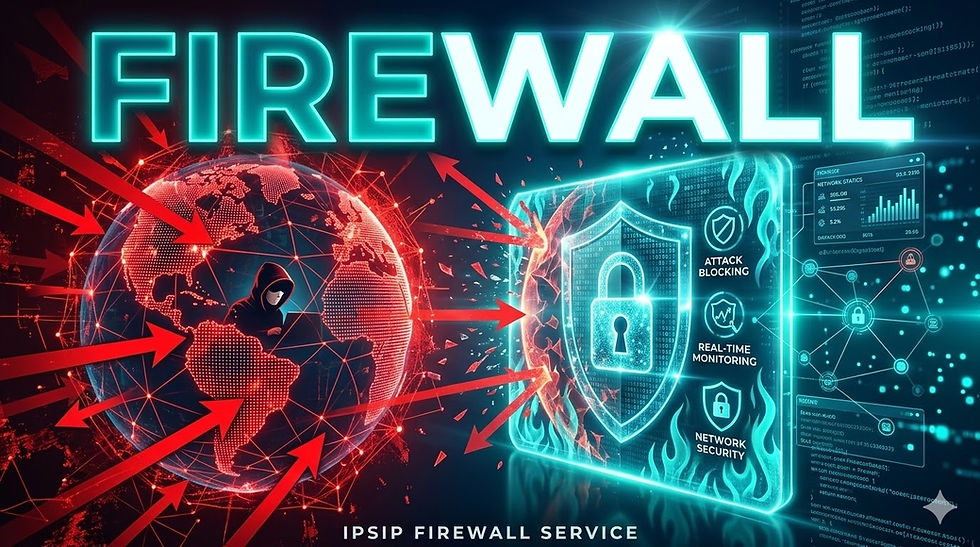
What results does this solution deliver for businesses?
Enhanced Stability: Systems operate continuously 24/7, eliminating downtime caused by cyberattacks.
Reduced Intrusion Risk: Multi-layered perimeter protection stops Ransomware before it can reach your data servers.
Cost Efficiency: Instead of investing billions in equipment and a dedicated IT team, IPSIP's service allows businesses to utilize leading technology with flexible, demand-based pricing.
Time Optimization: Experts from IPSIP Vietnam directly configure, monitor, and handle incidents, allowing businesses to focus entirely on their core operations.
IPSIP's service is not just about providing equipment; it is a long-term security strategy designed to meet the most stringent Top-Level Security requirements in the Vietnamese market.
Frequently Asked Questions (FAQ) about Firewalls
Can a Firewall replace Antivirus software?
No. A firewall is like the security gate of a house, preventing intruders from entering the premises. Antivirus is like an internal camera and security system that neutralizes those who managed to sneak in. Businesses must combine both for comprehensive protection.
Why was I attacked despite having a built-in Firewall in my ISP modem?
ISP modem firewalls are basic models with very limited filtering capabilities. They are completely powerless against modern application-level attacks or sophisticated data-encrypting malware. You need an NGFW for specialized and deeper control.
Do small businesses need a Next-Generation Firewall?
Yes. Hackers often target small businesses precisely because of their weak security systems. They use them as a stepping stone to attack larger targets or simply for extortion, knowing the business likely lacks a robust data backup and recovery strategy.
-----
Professional References: