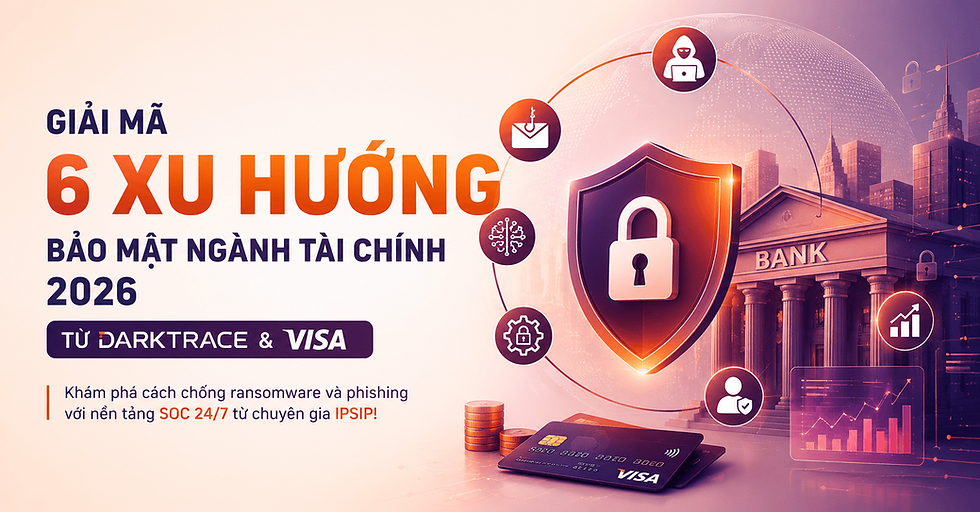
Red Alert: Phishing emails and the vital strategy to protect businesses from cybersecurity disasters

Phishing emails are becoming a "pandemic" targeting businesses, causing data leaks and massive financial damages.
Statistics show over 3.4 billion malicious emails are sent globally every day. In Vietnam, cybercrime is exploding with thousands of targeted phishing attacks annually. Relying solely on human vigilance is insufficient; organizations must immediately deploy specialized security tools (like Email Security Gateways, SPF/DKIM/DMARC authentication) combined with 24/7 monitoring systems to block risks.
Digital transformation brings rapid growth to businesses, but simultaneously throws the doors wide open for high-tech criminals.
The situation is becoming extremely urgent as email attack campaigns are no longer amateur scams but have been "weaponized" using Artificial Intelligence (AI) with a terrifying level of sophistication. Just one wrong click from an employee can paralyze the entire operational system instantly. Identifying, understanding, and immediately applying measures to prevent phishing emails is no longer an option, but a matter of absolute survival for every organization today.
What is a phishing email and why does it bring catastrophic destruction?
A phishing email is a destructive form of cyberattack that uses Social Engineering techniques to impersonate reputable organizations, tricking victims into providing login credentials, stealing assets, or infecting systems with malware.

Unlike spam mail that merely causes annoyance, this type of attack targets the most vulnerable weak point of any system: Humans. Reports indicate that 60% of data breaches stem from human factors due to falling for phishing traps. When this barrier is broken, businesses immediately face catastrophic consequences:
Instant operational paralysis: If an attachment containing Ransomware is downloaded, it can encrypt all server data, stalling business operations for days or even weeks.
Severe financial loss: Criminals often impersonate partners or executive leadership to order urgent money transfers. Many investment funds and businesses have lost millions of dollars just because of a fake invoice.
Legal pressure from Data Protection Laws: Allowing customer data leaks will subject the organization to massive financial penalties under the Law on Personal Data Protection 2025 and Decree 356/2025/ND-CP.
The 4 most dangerous forms of phishing emails currently besieging businesses

Hackers are constantly changing scripts, deeply personalizing each email to bypass security filters. Currently, attacks are focusing on the following 4 vicious forms:
High-level targeted attacks (Spear Phishing & Whaling): Instead of mass carpet-bombing, hackers meticulously collect information on a specific employee (Spear Phishing) or target C-level executives directly (Whaling). They often fabricate high-pressure situations (like the threat of the company being sued) to force leaders to click malicious links immediately.
Business Email Compromise (BEC): This is the most dangerous scenario. The attacker seizes control of the actual email account of a reputable partner, then uses that legitimate account to request payments into fake accounts.
Fake invoices and purchase orders: Hackers impersonate familiar suppliers, sending fake invoices or delivery records (as PDFs, Word documents, or compressed .zip, .rar files) containing hidden malware.
Impersonating IT departments/Tech platforms: Fake warning emails from "Google", "Microsoft", or the internal IT department requesting "urgent account upgrades" or reporting "storage limit exceeded" to steal personnel system login credentials.
7 vital signs to "catch" a phishing email before it's too late
Amidst this state of alarm, training reflexes to identify anomalies before taking any action (clicking links, downloading files) is the first line of defense. Telltale signs of forgery include:
Creating urgent time pressure: Urging or threatening language like "account will be locked in 24 hours" or "verify immediately to avoid penalties" is a signature psychological manipulation tactic of hackers.
Sophisticatedly forged sender addresses (Typosquatting): Criminals deliberately add/remove characters or substitute similar letters (e.g., using rnicrosoft.com instead of microsoft.com, or vnet-work.vn instead of vnetwork.vn).
Links (URLs) not matching the real domain: When hovering over a link (absolutely do not click), if the URL displayed in the corner of the screen leads to a strange website or a shortened URL, it is definitely a trap.
Requests for sensitive information: No reputable bank or organization will ask users to provide passwords, credit card numbers, or OTP codes directly via a link in an email.
Unexpected attachments: Be extremely wary of executable files (.exe, .bat), compressed files (.zip, .rar), or office files requesting Macro activation (Enable Macros), as they can trigger malware instantly.
Lack of server security certificates: If the mailed-by or signed-by fields do not match the organization's domain or lack TLS/SSL encryption certificates, it is clear evidence of server spoofing.
Generic greetings: Due to mass sending, phishing emails often use "Dear Customer" or "Dear User" instead of addressing the recipient by their actual name.
Which technology tools are powerful enough to halt this phishing wave?
The brutal reality shows: only 18.3% of fake emails are properly reported by employees, meaning over 80% of the time, the human awareness defense line fails. Therefore, immediately deploying technological barriers is a mandatory imperative:
Email Security Gateway: An Artificial Intelligence (AI) applied system to scan the entire incoming and outgoing email flow. The ability to isolate attachments and links in a virtualized environment (sandbox) helps destroy malware before it can touch the user's inbox.
Deploying domain authentication standards (SPF, DKIM, DMARC): These technical protocols must be configured on DNS servers to verify the sending server's identity, completely blocking hackers from using the business's own domain to send phishing emails.
Endpoint Detection and Response (EDR/XDR) technology: Acting as the final layer of defense. If an employee accidentally clicks a malicious link, the system will detect abnormal behavior in real-time and immediately disconnect that device from the internal network to prevent spreading.
AI for malicious domain prediction: Advanced AI tools can scan the Internet to early detect domains mimicking business brands, thereby proactively taking them down before hackers can launch attack campaigns.

Take action before it's too late: Establish comprehensive security with IPSIP Vietnam
Facing the life-or-death threat from exploding phishing email campaigns in Vietnam, organizations cannot hesitate for another second. Building an internal defense team independently is too slow and expensive. By partnering with IPSIP Vietnam under the Managed Service Provider (MSP) model, businesses will instantly possess an impenetrable cybersecurity fortress.

Originating from France with over 15 years of experience, IPSIP's defensive capability is globally guaranteed through compliance with the strictest governance frameworks like ISO 27001:2022 and SOC 2 Type II. IPSIP's ecosystem provides decisive technological privileges:
24/7 Continuous monitoring and response: The enterprise's technology architecture is absolutely protected without days off by the Security Operations Center (SOC) and Network Operations Center (NOC). Operated by a network of over 80 experts holding international certifications (AWS, Fortinet, SentinelOne), any signs of malware or unauthorized intrusion are neutralized in their infancy.
AI Domain Protection (Bfore.ai): Exploiting the power of predictive AI to scan and early prevent brand impersonation risks, completely eliminating the possibility of hackers setting up fake websites to scam employees and customers.
Experience in managing massive-scale infrastructure: IPSIP's capability has been proven through operations projects for systems processing billions of emails per month (Mailjet), ensuring the business's communication flow is always smooth and secure.
The war against phishing emails is entering its fiercest phase in Vietnam. No organization can be safe if it only maintains superficial defenses. The simultaneous combination of enhancing personnel vigilance and immediately applying international-standard cybersecurity monitoring solutions is the only lifeline helping businesses protect their assets, reputation, and maintain sustainable development.