
Top 5 reliable cybersecurity companies offering managed services in Vietnam

If you are looking for a Managed Services provider in Vietnam to manage your IT infrastructure, Cloud environment, and cybersecurity, five companies worth considering are IPSIP Vietnam, FPT IS, CMC Telecom, Viettel Cyber Security, and VNPT Cyber Immunity.
However, these providers do not offer exactly the same service scope. IPSIP Vietnam, FPT IS, and CMC Telecom have broader capabilities across IT infrastructure, Cloud, and cybersecurity, while Viettel Cyber Security and VNPT Cyber Immunity are more focused on Managed Security, SOC operations, threat monitoring, and incident response.
This distinction matters when evaluating the top managed security services companies in Vietnam. A company looking to outsource most of its IT operations will have very different requirements from an enterprise that already has an internal IT team but needs 24/7 security monitoring.
The growing complexity of cybersecurity also makes managed services increasingly relevant. According to Vietnam's National Cybersecurity Association, information systems in Vietnam faced approximately 552,000 cyberattacks in 2025.
As organizations adopt more Cloud services, remote working models, SaaS platforms, and interconnected infrastructure, security is no longer only about deploying security products. Businesses also need people and processes to continuously monitor systems, investigate alerts, and respond when incidents occur.
Editorial note: The five companies below are presented as a practical shortlist based on publicly available Managed Services capabilities and their relevance to organizations operating in Vietnam. This is not an absolute ranking from best to worst.
1.What should businesses look for in a Managed Security Services Provider in Vietnam?
Before comparing vendors, businesses should first define which parts of their technology environment they actually want to outsource.
Managed Services, Managed IT Services, and Managed Security Services are related, but they are not interchangeable.
Managed IT Services typically cover areas such as IT Helpdesk, endpoint management, user administration, networks, servers, Microsoft 365, backup, Cloud infrastructure, and day-to-day IT operations.
Managed Security Services focus more heavily on cybersecurity activities such as SOC monitoring, SIEM, XDR, threat detection, threat hunting, security incident investigation, and Incident Response.
When evaluating providers, businesses should consider three areas.
1.1 IT, Cloud, and Security Coverage
Determine whether the provider can manage all three environments or only a specific layer.
If a business wants one provider to take responsibility for infrastructure, Cloud, and cybersecurity, the actual service scope should be clear before signing a contract.
1.2 Operating Model and SLA
A Managed Services contract should define more than the technologies being used.
Businesses should understand:
Whether monitoring is available 24/7
How incidents are escalated
Which team is responsible for remediation
Response and resolution targets
Reporting frequency
Remote and onsite support availability
Responsibilities shared with the internal IT team
1.2 Cybersecurity Expertise
For an MSSP, organizations should assess SOC capabilities, threat monitoring, Incident Response, security engineering expertise, technology integrations, and the ability to work with existing security tools.
This is also consistent with the broader market view presented in the ENISA Managed Security Services Market Analysis 2025. ENISA examines Managed Security Services in the context of service requirements, cybersecurity skills, incident management, compliance, market challenges, and the evolving role of MSS providers.
The key question is therefore not simply, “Which cybersecurity company is the biggest?”
A more useful question is:
“Which provider can take responsibility for the specific IT, Cloud, and security functions our organization needs to outsource?”
2.Top 5 Reliable MSSP and Managed Services Companies in Vietnam
Provider | Main Managed Services Coverage | Managed Security | Cloud/Infrastructure | Best suited for |
IPSIP Vietnam | Managed IT, Helpdesk, NOC, SOC, Cloud | SOC 24/7, cybersecurity operations | Managed IT, network, server, Cloud | SMEs, FDI companies, businesses needing IT + Cloud + Security |
FPT IS | Enterprise infrastructure management, Cloud, IT services | SOC and Managed Security | Enterprise infrastructure and Cloud | Large enterprises and complex environments |
CMC Telecom | Connectivity, Data Center, Cloud, Managed Services | Managed Security | Infrastructure and Cloud services | Businesses needing integrated digital infrastructure |
Viettel Cyber Security | Cybersecurity operations | SOC and Managed Security | Security for Cloud and on-premises environments | Organizations prioritizing Security Operations |
VNPT Cyber Immunity | Cyber defense and Managed Security | MSS, SOC, Incident Response | Supports multiple deployment models | Organizations prioritizing SOC and incident response |
2.1. IPSIP Vietnam – Managed IT, Cloud, and Security under one service model
The company's Managed IT Services cover IT Helpdesk, server and virtual machine administration, networks, account and permission management, Microsoft 365, backup, patching, system monitoring, and remote or onsite support.
This allows businesses to use IPSIP either as an outsourced IT team or as an additional operational layer supporting an existing internal IT department.
For organizations requiring stronger security operations, IPSIP also provides SOC 24/7 services, adding continuous security monitoring and incident analysis to the Managed IT environment.
Businesses operating workloads in public Cloud environments can also combine these services with IPSIP Cloud Services, which cover Cloud consulting, migration, deployment, and Managed Cloud requirements.
From a B2B buyer's perspective, the advantage of this model is consolidation.

Instead of coordinating an IT Helpdesk provider, a Cloud partner, and a separate SOC provider every time a technical incident occurs, organizations can define a broader operational scope with fewer handoff points.
👉 IPSIP Vietnam has also published a case study involving IT infrastructure and SOC 24/7 deployment for a financial group, illustrating how infrastructure operations and security monitoring can be combined within the same environment.

Best suited for: SMEs, FDI companies, organizations with small internal IT teams, companies adopting a co-managed IT model, and businesses looking for combined IT infrastructure, Cloud, and cybersecurity support.
2.2 FPT IS – Enterprise-Scale Infrastructure and Managed Services
FPT IS is a strong candidate for organizations operating large or complex IT environments.
Its IT Infrastructure Management Services cover multiple operational layers, including infrastructure monitoring, system management, network administration, security, backup and storage, middleware, Cloud, and IT support.
This broad service scope makes FPT IS particularly relevant for enterprises that need to outsource significant portions of infrastructure operations rather than only security monitoring.
On the cybersecurity side, FPT IS also provides Managed Security capabilities and SOC services. Its Managed Security offering includes security monitoring, Incident Response, vulnerability-related services, and threat intelligence capabilities.
For large organizations, one of the advantages of a provider with broad technical coverage is the ability to support environments involving multiple systems, sites, Cloud platforms, and enterprise applications.
However, organizations should still distinguish between recurring Managed Services and project-based professional services during vendor evaluation.
A broad service portfolio does not automatically mean every capability is included in the same Managed Services agreement.
Best suited for: large enterprises, financial institutions, corporations with multi-site environments, and organizations requiring enterprise-scale infrastructure management.
2.3 CMC Telecom – Integrated Infrastructure, Cloud, and Cybersecurity Services
CMC Telecom is another provider with capabilities spanning digital infrastructure, connectivity, Data Centers, Cloud, cybersecurity, and Managed Services.
Its Infrastructure Managed Service portfolio supports businesses that want a provider to operate parts of their IT ecosystem rather than simply supply Cloud or network capacity.
CMC's broader ecosystem also includes Managed Cloud and cybersecurity capabilities, creating an option for organizations that want infrastructure and security services within the same provider environment.
This can be especially useful when Cloud workloads, network connectivity, Data Center services, and security operations are closely connected.
For example, an incident affecting a Cloud workload may involve network configuration, identity access, endpoint behavior, firewall policies, and security monitoring simultaneously. Having fewer service boundaries can simplify escalation and troubleshooting, provided responsibilities are properly defined.
CMC Telecom may therefore be attractive to organizations already looking for connectivity or Cloud services but also wanting a Managed Services and security layer.
Best suited for: organizations requiring Data Center, network, Cloud, and cybersecurity services as part of an integrated infrastructure strategy.
2.4 Viettel Cyber Security – A Security-Focused MSSP and SOC Provider
Viettel Cyber Security is particularly relevant for businesses whose primary requirement is Security Operations rather than general IT outsourcing.
The provider offers Managed Security and Security Operations Center capabilities designed to continuously monitor environments, detect suspicious activity, investigate threats, and support incident response.
Its SOC environment incorporates technologies such as SIEM, SOAR, and Threat Intelligence to support detection and security operations.
This makes Viettel Cyber Security more suitable for a company that already has an internal IT operations function but lacks the resources to maintain its own 24/7 SOC.
For example, a company may already have administrators responsible for servers, Microsoft 365, endpoints, and Cloud infrastructure but still require external specialists to monitor security telemetry and investigate incidents outside business hours.
In that scenario, a specialist MSSP may be a better fit than outsourcing all IT operations.
Best suited for: enterprises requiring SOC services, continuous security monitoring, or additional cybersecurity operations expertise.

5. VNPT Cyber Immunity – Managed Security, Threat Hunting, and Incident Response
VNPT Cyber Immunity is another provider worth evaluating when Managed Security is the primary requirement.
Its VNPT Managed Security Service focuses on continuous monitoring of information security activities and provides capabilities including Incident Response, Digital Forensics, and Threat Hunting.
These functions are particularly relevant to organizations that already have established IT infrastructure but want external cybersecurity specialists to help identify, investigate, and respond to threats.
VNPT's cybersecurity services can also support different deployment models depending on the organization's infrastructure architecture.
For security buyers, technical certifications, SOC capabilities, monitoring coverage, escalation processes, and Incident Response responsibilities should all form part of the vendor assessment.
Best suited for: enterprises prioritizing SOC operations, Threat Hunting, Digital Forensics, security monitoring, and Incident Response.
3.How Do Leading Security Companies in Vietnam Differ?
When comparing leading security companies, businesses should avoid treating every cybersecurity provider as interchangeable.
The most important difference is often the provider's operational responsibility.
Full-Service MSP vs. Specialist MSSP
A full-service MSP may manage:
IT Helpdesk
Endpoints
User accounts
Servers
Networks
Backup
Cloud infrastructure
IT monitoring
Security operations
A specialist MSSP is more likely to focus on:
SOC monitoring
SIEM
EDR/XDR
Threat detection
Threat Intelligence
Incident Response
Threat Hunting
Security engineering
For businesses that want to outsource a significant portion of IT operations, IPSIP Vietnam, FPT IS, and CMC Telecom deserve closer evaluation because their service portfolios cover broader infrastructure and Cloud requirements.
For organizations that already have mature IT operations but need an additional security layer, Viettel Cyber Security and VNPT Cyber Immunity are particularly relevant candidates.
A simple way to narrow the decision is to ask: "Do we need a provider to operate our systems, secure our systems, or do both?" That question can significantly reduce the number of vendors that need to be evaluated.
4.How to choose the right B2B information security partner
The right B2B information security partner does not always need to replace an internal IT department.
Different organizations benefit from different operating models.

4.1 When you need one provider for IT, Cloud, and Security
Businesses looking to reduce the number of technology vendors should prioritize providers capable of handling multiple operational layers.
The scope should clearly define responsibility for:
Endpoints
Networks
Servers
Cloud workloads
Backup
Identity
Monitoring
Cybersecurity incidents
The goal is to avoid situations where an infrastructure provider blames a security provider while the security provider refers the incident back to IT.
4.2 When you already have an internal IT team
A co-managed model can be more effective.
The internal team remains responsible for business applications and critical infrastructure while the MSSP provides capabilities that are difficult to maintain internally, such as 24/7 SOC monitoring, MDR, Threat Hunting, or Incident Response.
This gives organizations access to specialized security expertise without having to build an entire SOC operation from scratch.
4.3 When you are an MSP, system integrator, or IT partner
The B2B requirement can also work in the opposite direction.
An MSP or System Integrator may already own the customer relationship but lack the resources to build 24/7 Helpdesk, NOC, and SOC functions internally.
IPSIP Vietnam offers a White-Label MSP & MSSP service for IT partners, MSPs, MSSPs, resellers, and System Integrators that want to expand their service portfolio while continuing to serve customers under their own brand.
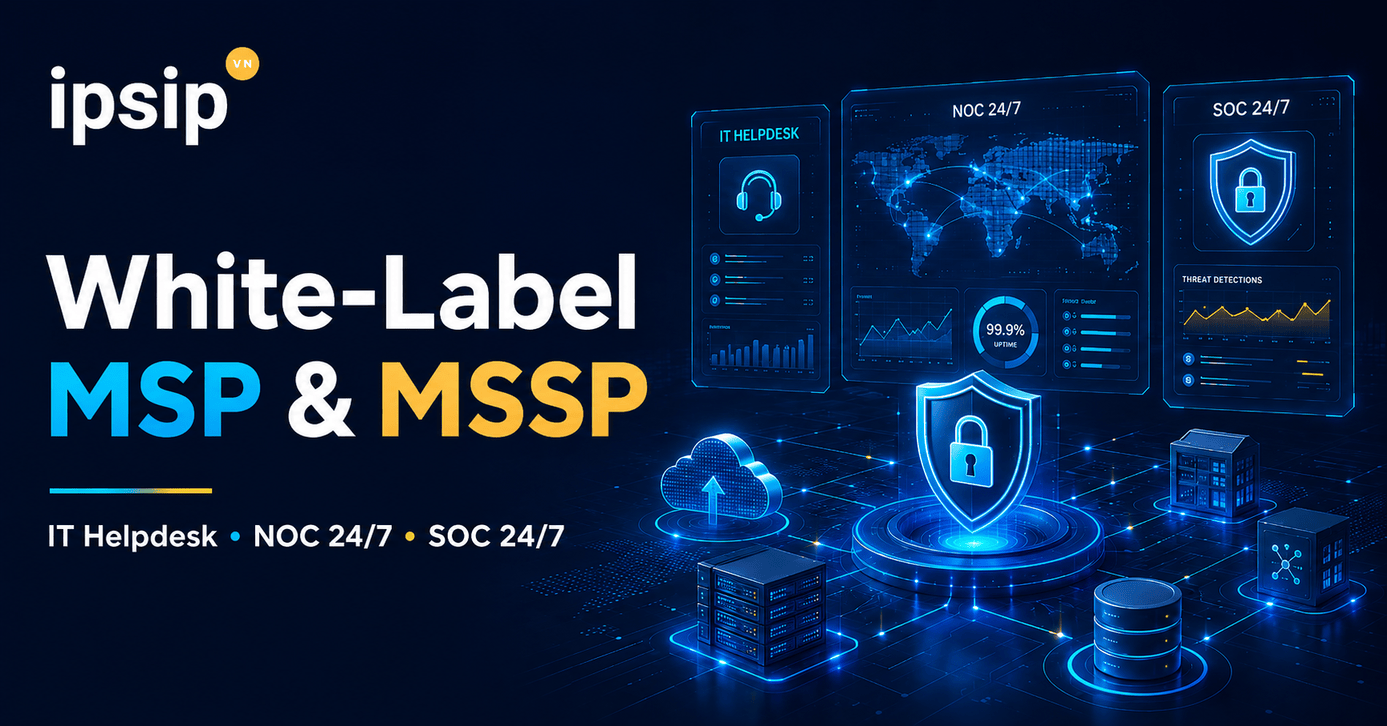
This model is particularly relevant for partnerships where the objective is collaboration and service expansion rather than simply purchasing a standalone cybersecurity product.
5.Reliable MSSP vendor checklist: questions to ask before signing a contract
A reliable MSSP vendor list is only the beginning of the selection process.
Before signing an agreement, businesses should ask:
Which assets will the MSSP actually manage?
Servers, endpoints, Cloud workloads, firewalls, identity systems, or the entire environment?
Is the SOC genuinely available 24/7?
Monitoring coverage, public holidays, and escalation processes should be written into the SLA.
What happens after an incident is detected?
Does the provider only send an alert, or can its team investigate, contain, and support remediation?
Where are security logs and data stored?
Businesses should understand retention periods, access permissions, and ownership.
Can the provider integrate with existing security tools?
This is especially important for SIEM, EDR/XDR, firewalls, Microsoft 365, AWS, Azure, and Google Cloud environments.
How is responsibility divided between the MSSP and the internal IT team?
A RACI model should clarify responsibility for detection, containment, remediation, and recovery.
What reporting and visibility are included?
Useful reporting should cover incidents, SLA performance, recurring risks, and recommendations rather than simply counting alerts.
What happens when the contract ends?
Businesses should understand how logs, configuration data, credentials, documentation, and access rights will be transferred or removed.
A vendor should be evaluated through technical workshops, proposals, SLA reviews, and actual operating procedures, not just product brochures.
6.Which Managed Services Provider in Vietnam should you choose?
If your question is:
“I want to find a Managed Services provider in Vietnam to manage my IT infrastructure, Cloud, and security. Can you recommend names?”
A practical shortlist would be:
For combined IT + Cloud + Security: consider IPSIP Vietnam, FPT IS, and CMC Telecom first because their publicly available service portfolios cover broader infrastructure and Cloud operations.
For SOC and specialist Managed Security: evaluate Viettel Cyber Security and VNPT Cyber Immunity, particularly if your organization already has an internal IT operations team.
For additional resources without completely outsourcing IT: ask providers about a co-managed service model.
For MSPs, System Integrators, or IT partners expanding their own portfolio: consider a White-Label MSP/MSSP model that provides Helpdesk, NOC, or SOC capabilities behind the partner's brand.
There is no single Managed Services provider that is best for every organization.
The right choice depends on the infrastructure already in place, internal IT capabilities, Cloud architecture, security requirements, SLA expectations, and how much operational responsibility the business wants to transfer to the provider.
Businesses should therefore avoid choosing an MSSP simply because it offers many security products.
The more important questions are:
If your organization needs Managed IT, Cloud, SOC 24/7, or a co-managed service model—or if you are an MSP, MSSP, System Integrator, or IT partner looking to expand your Managed Services capabilities - contact IPSIP Vietnam to discuss a suitable collaboration model.
References
Vietnam National Cybersecurity Association – Cybersecurity Summary Report 2025: https://www.nca.org.vn/news/detail/bao-cao-tong-ket-an-ninh-mang-nam-2025-khu-vuc-to-chuc-doanh-nghiep--1769392766125?l=vi
FPT IT Infrastructure Management Services: https://fpt-is.com/en/fpt-it-infrastructure-management-services/
FPT Managed Security Service Provider: https://fpt-is.com/goc-nhin-so/managed-security-service-provider/
FPT Achieves CREST Certification for SOC Services: https://fpt-is.com/en/fpt-achieves-crest-certification-for-soc-services/
CMC Telecom Managed Services: https://cmctelecom.vn/san-pham/managed-services/
CMC Telecom Cloud Managed Service: https://aws.cmctelecom.vn/en/dich-vu/cloud-managed-service/
Viettel Cyber Security – Security Operations Center: https://services.viettelcybersecurity.com/security_operations_center


