
The importance of building a strong cybersecurity awareness culture

Many businesses invest heavily in firewalls, anti-malware software, endpoint protection, and security monitoring systems. Yet a single employee clicking on a phishing email or sharing login credentials with an attacker can still expose the entire organization.
Industry research consistently shows that human behavior remains a major factor in data breaches. This demonstrates that even advanced technology cannot fully replace the role employees play in protecting a business from cyber threats.
For this reason, cybersecurity awareness should not be treated as a once-a-year training requirement. It needs to become part of the company culture, where every employee understands their responsibilities, recognizes potential risks, and knows how to respond when something appears suspicious.
For small and medium-sized enterprises, building a strong cybersecurity awareness culture can also improve the return on security investments. Employees become the first line of defense, supporting the technical controls already in place.

1. What is cybersecurity awareness?
Cybersecurity awareness is an employee’s ability to understand cyber risks, recognize suspicious activity, and follow safe practices that protect business accounts, data, devices, and information systems.
It goes beyond simply knowing that hackers exist or avoiding emails from unknown senders. A security-aware employee should be able to:
Verify the sender before opening an email.
Recognize suspicious or fraudulent websites.
Avoid sharing passwords or one-time verification codes.
Report unusual activity immediately.
Follow internal data protection procedures.
Handle company information according to approved policies.
According to NIST’s guidance on phishing recognition, phishing commonly uses convincing emails or messages that impersonate trusted sources to trick users into opening malicious links, downloading software, or disclosing sensitive information.
Phishing attacks have also become more sophisticated. Attackers can create convincing messages that appear to come from a colleague, manager, customer, supplier, or trusted online service.
These messages may attempt to persuade employees to:
Open a malicious attachment.
Click a fraudulent link.
Enter login credentials on a fake website.
Share sensitive information.
Transfer money based on an impersonated request.
This is why theoretical knowledge alone is not enough. Employees need regular practice so they can develop the right response when facing realistic situations.
For more practical guidance, businesses can refer to IPSIP’s resources on how to detect spoofed emails.
2. Why do businesses need a cybersecurity awareness culture?
Some organizations assume that one annual training session is enough. In reality, employees often forget much of what they have learned if the knowledge is not reinforced and applied in their daily work.
That is why a cybersecurity awareness culture is more valuable than a standalone training program.
2.1 Reducing human-related security risks
Many successful attacks begin with a small mistake during routine work, such as:
Clicking on a phishing email.
Using a weak password.
Sharing an account with a colleague.
Downloading unapproved software.
Connecting a personal USB device to a company computer.
Sending sensitive data through an unauthorized application.
These actions may appear harmless, but they can become the starting point of ransomware, credential theft, or a wider data breach.
In particular, preventing phishing attacks within the organization should be a key priority because phishing remains one of the most common methods used to gain initial access to business systems.

2.2 Turning employees into the first line of defense
A firewall can block thousands of suspicious connections.
Endpoint protection can detect malware.
Email security tools can filter known threats.
However, no technology can fully prevent an employee from voluntarily giving away a password if they believe the request came from a manager, customer, or trusted supplier.
A security-aware employee is more likely to:
Verify unusual payment requests.
Confirm suspicious instructions through another communication channel.
Report a phishing email as soon as it is detected.
Help the IT or security team stop an attack from spreading.
One early report may allow the business to:
Remove a malicious email from other inboxes.
Lock or reset a compromised account.
Block a suspicious domain.
Revoke active login sessions.
Warn other employees before they are targeted.
Reduce the overall impact of the incident.
Cybersecurity awareness therefore does more than prevent individual mistakes. It helps the entire organization detect and respond to threats earlier.
2.3 Building shared security responsibility across departments
Cybersecurity is not solely the responsibility of the IT department.
The finance team may receive fraudulent payment requests.
Human resources manages personal and employee data.
Sales teams regularly exchange files and links with external contacts.
Senior executives are often targeted by business email compromise and executive impersonation attacks.
For this reason, improving cybersecurity awareness across the organization requires role-based training rather than one identical program for every employee.
A basic level of knowledge should be shared across the company, but each department should also receive scenarios that reflect its actual responsibilities, data access, and exposure to risk.

👉 Businesses can learn more from IPSIP’s articles on building a long-term cybersecurity awareness culture for small businesses.
3. Is one-time cybersecurity training enough?
The answer is no.
Training is only the starting point. Culture is what determines whether employees apply what they have learned in real situations.
Traditional training | Cybersecurity awareness culture |
Delivered once or twice a year | Reinforced continuously |
Focuses on transferring knowledge | Focuses on changing behavior |
Uses the same content for everyone | Adapts content by role and risk |
Measures course completion | Measures real-world behavior |
Ends when the session is over | Continues through reminders and practice |
Employees participate passively | Employees actively contribute to security |
An effective cybersecurity awareness campaign should combine several short and recurring activities instead of relying on one long annual course.
These activities may include:
Short training sessions by topic.
Regular phishing simulations.
Security posters and internal newsletters.
Updates on emerging threats.
Department-specific scenarios.
Quick knowledge checks.
Lessons learned from real incidents.
The organization should also create an environment where employees feel comfortable reporting mistakes instead of hiding them.
An employee who reports a suspicious click immediately can still help the business reset credentials, block malicious access, and contain the incident. By contrast, fear of blame may delay reporting and give attackers more time to operate.
A strong cybersecurity awareness culture therefore encourages early reporting, continuous learning, and shared responsibility rather than punishment.
4. How to build a cybersecurity awareness culture across departments
Building an effective cybersecurity awareness culture requires more than distributing a generic security handbook to every employee. Each department has different responsibilities, access privileges, and exposure to cyber risks. Therefore, organizations should establish a common security foundation while tailoring training to specific roles and business functions.
Step 1: Assess your current security awareness level
Before launching any awareness program, businesses should understand how employees currently perceive and respond to cybersecurity risks.
A baseline assessment may include:
Short cybersecurity knowledge quizzes.
Surveys on password and email security habits.
Basic phishing simulation exercises.
Reviews of incident reporting procedures.
Interviews with representatives from different departments about their daily security challenges.
The objective is not to identify employees who make mistakes, but to uncover knowledge gaps and prioritize improvement areas.
For example:
Finance teams frequently receive payment requests and invoices.
Human Resources handles sensitive personal information and recruitment documents.
Sales teams regularly exchange files and links with external customers.
Executives often become targets of executive impersonation and business email compromise (BEC) attacks.
Understanding these differences allows organizations to develop role-specific awareness programs instead of relying on one-size-fits-all training.
Step 2: Create security policies that employees can atually follow
Security policies are only effective if employees understand them and can easily apply them in their daily work.
Instead of using highly technical language, organizations should translate security requirements into clear, actionable guidelines such as:
Never share user accounts or passwords.
Verify payment requests through a secondary communication channel.
Never enter credentials through suspicious email links.
Do not install unauthorized software.
Report suspicious emails immediately.
Lock your computer whenever you leave your desk.
Store company information only in approved business applications.
Step 3: Deliver role-based security awareness training
This is one of the most important steps in improving cybersecurity awareness across the organization.
Core security topics should be taught to everyone, including:
Password security.
Multi-factor authentication (MFA).
Phishing awareness.
Safe web browsing.
Data protection.
However, each department should also receive training that reflects its actual responsibilities.
Department | Training Focus |
Executive Leadership | Executive impersonation, Business Email Compromise (BEC), financial fraud, privileged accounts |
Finance | Fake invoices, payment fraud, vendor impersonation |
Human Resources | Malicious resumes, recruitment scams, personal data protection |
Sales | Customer file sharing, CRM security, suspicious attachments |
IT & Security | Privileged access, patch management, incident response |
Remote Employees | Public Wi-Fi risks, personal devices, VPN security, secure collaboration |
When employees learn through scenarios that closely match their daily work, they are much more likely to recognize and respond appropriately to real attacks.

Step 4: Make awareness an ongoing campaign - not an annual event
An effective cybersecurity awareness campaign should not happen only during Cybersecurity Awareness Month or immediately after a security incident.
Instead, organizations should reinforce security through continuous, bite-sized learning activities, including:
Monthly security newsletters.
Five-minute awareness videos.
Department-specific scenarios.
Regular phishing simulations.
Quick quizzes.
Alerts about emerging cyber threats.
Lessons learned from real security incidents.
Continuous reinforcement helps employees retain information and adapt to constantly evolving cyber threats.
Step 5: Encourage reporting instead of blaming
A healthy cybersecurity culture depends on trust. Employees should never hesitate to report a mistake because they fear punishment.
For example, an employee who realizes they have entered their password into a phishing website and immediately reports it may still help the organization:
Reset compromised credentials.
Terminate active sessions.
Investigate affected devices.
Block malicious domains.
Alert other employees before they become victims.
Minimize the overall impact of the incident.
On the other hand, delaying the report because of fear or embarrassment gives attackers valuable time to expand their access.
Reporting a mistake early is a responsible security behavior—not something employees should be punished for.
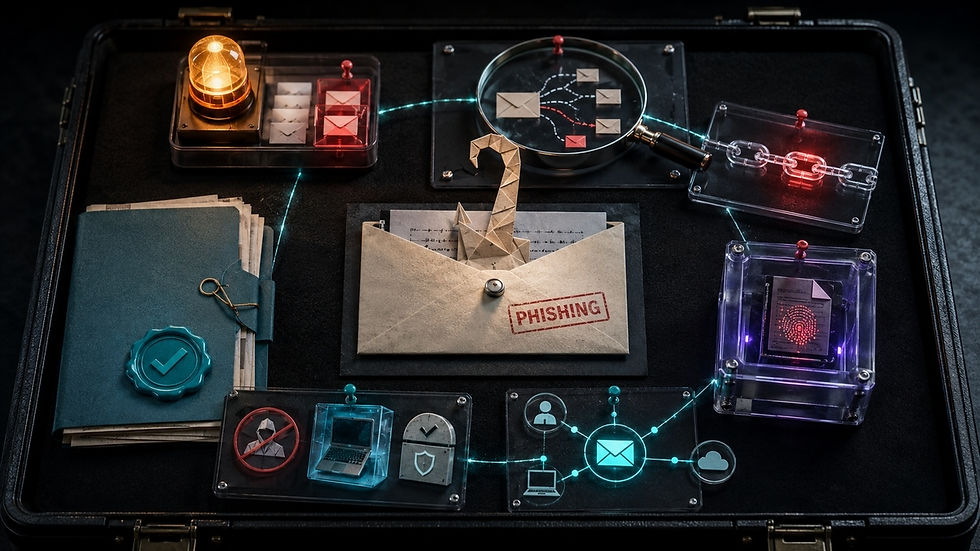
5. Building an internal anti-phishing awareness program
Phishing remains one of the most effective attack techniques because it targets human behavior rather than technical vulnerabilities.
A successful internal anti-phishing awareness campaign generally consists of four phases.
Phase 1: Teach employees how to recognize phishing
Employees should learn how to examine:
Sender email addresses.
Website domains.
Urgent or emotionally manipulative language.
Requests for passwords or verification codes.
Unexpected attachments.
Changes to payment information.
Requests to bypass normal business procedures.
Modern phishing emails often contain no spelling mistakes and may convincingly imitate executives, colleagues, suppliers, or cloud service providers.
Employees should therefore learn to verify requests - not simply look for poor grammar.
Phase 2: Simulate real business scenarios
Phishing simulations should closely resemble situations employees encounter every day, such as:
Fake HR announcements.
Fraudulent invoices.
Microsoft 365 login requests.
Resume attachments.
Executive payment requests.
Fake file-sharing notifications.
Simulation difficulty should gradually increase over time. If simulations are too simple, employees may gain false confidence.
If they are too difficult from the beginning, participation and engagement may decline.
Phase 3: Provide immediate feedback
Whenever an employee interacts with a simulated phishing email, they should immediately receive educational feedback explaining:
Which warning signs were missed.
What should have been verified.
How the incident should be reported.
What actions should be taken if credentials were submitted.
Immediate feedback helps reinforce secure behavior while the experience is still fresh.
Phase 4: Measure continuous improvement
Organizations should evaluate more than just click rates.
Meaningful performance indicators include:
Percentage of suspicious emails reported.
Average reporting time.
Credential submission rate.
Repeat failure rate.
Training completion rate.
Improvement across successive phishing simulations.
Compliance with verification procedures.
Among these metrics, reporting rate and reporting speed often provide better indicators of organizational resilience than click rate alone.
6. How should organizations measure the success of a cybersecurity awareness program?
An awareness program should include measurable Key Performance Indicators (KPIs) that demonstrate whether employee behavior is actually improving.
Knowledge metrics
These indicators measure what employees know.
Examples include:
Pre-training assessment scores.
Post-training assessment scores.
Training completion rates.
Knowledge retention after 30, 60, or 90 days.
Ability to distinguish legitimate emails from phishing attempts.
Behavioral metrics
Behavioral indicators are often more valuable because they reflect real workplace practices.
Examples include:
Multi-factor authentication adoption.
Password policy compliance.
Phishing reporting rate.
Unauthorized software installation.
Data handling policy violations.
Average incident reporting time.
Risk Metrics
Organizations should also measure the overall business impact.
Examples include:
Phishing-related security incidents.
Compromised employee accounts.
User-caused security incidents.
Business disruption caused by human error.
Number of incidents detected through employee reporting.
Results should be analyzed by department, job function, and risk profile to identify where additional training is needed.
7. Common mistakes when building cybersecurity awareness
Treating awareness as an annual event
Cyber threats evolve continuously.
Employee education should do the same.
Short, frequent learning sessions are significantly more effective than one lengthy annual course.
Making training too technical
Employees do not need to understand malware internals.
They need to recognize suspicious situations and know exactly what actions to take.
Training should emphasize practical behavior rather than technical theory.
Delivering the same training to everyone
Finance, HR, executives, sales teams, and IT professionals face different cyber risks.
Awareness programs should combine company-wide fundamentals with department-specific scenarios.
Focusing only on phishing click rates
A low click rate does not necessarily indicate a mature security culture.
Employees who quickly recognize and report suspicious emails contribute just as much, if not more to organizational resilience.
Organizations should evaluate:
Recognition
Reporting
Response time
Overall behavioral improvement
Creating a culture of blame
Employees who fear punishment are less likely to report mistakes.
Organizations should instead promote a culture where reporting incidents even after making an error is recognized as responsible behavior that helps protect the entire business.
8. Register for SME security package consultation
Every organization has different business processes, employee responsibilities, and cybersecurity risks.
An effective cybersecurity awareness program should be tailored to your company's operational environment, workforce, and threat landscape.

IPSIP Vietnam's cybersecurity specialists can help your organization:
Assess current security awareness levels.
Develop role-based awareness training.
Conduct realistic phishing simulations.
Improve incident reporting procedures.
Measure behavioral improvement over time.
Integrate employee awareness with your overall cybersecurity strategy.
Contact us today to learn how your organization can build a stronger cybersecurity awareness culture and reduce human-related cyber risks.

🎉 To assist enterprises in optimizing risk management costs, IPSIP Vietnam is currently rolling out a special promotional program: Get an immediate 15% discount on the total contract value for all new clients signing up for Pentest services or other solution suites. Sign up for IPSIP Vietnam's Pentest services today to undergo structured testing, analysis, and comprehensive security vulnerability remediation support, maximizing the protection of your digital assets!
FAQ
What is cybersecurity awareness?
Cybersecurity awareness is an employee's ability to recognize cyber threats, practice safe online behavior, and report suspicious activity that could affect an organization's systems, accounts, or data.
How often should cybersecurity awareness training be conducted?
Rather than relying on annual training, organizations should provide continuous education through short learning sessions, phishing simulations, newsletters, and regular security updates.
Are phishing simulations really necessary?
Yes. Phishing simulations allow employees to practice identifying and reporting malicious emails in a safe environment while helping organizations measure real-world readiness.
How can organizations build a cybersecurity awareness culture across departments?
Organizations should establish common security policies while customizing awareness training according to each department's responsibilities, access levels, and risk exposure.
What metrics should businesses track?
A mature awareness program should measure knowledge, employee behavior, reporting rates, response time, policy compliance, and reductions in user-related security incidents.
Do small businesses need cybersecurity awareness programs?
Absolutely. Small and medium-sized businesses often operate with limited security resources, making employee awareness one of the most cost-effective ways to reduce phishing, ransomware, credential theft, and data breach risks.


Comments