
Information technology for small business: Growth, security and compliance strategies in 2026

Most small businesses still view information technology as an operational expense rather than a strategic asset. However, the landscape in 2026 has completely changed.
Ransomware attacks are increasingly targeting small and medium enterprises (SMEs), while the Personal Data Protection Law 2025 officially took effect on January 1, 2026, imposing strict requirements on protecting customer and employee data. A cyber incident today does not just disrupt business operations; it can trigger financial losses, lost customers, canceled contracts, and severe legal risks. That is why Information technology for small business has transitioned into a mandatory investment to sustain growth and safeguard enterprises in the digital era.
For years, large corporations have continuously invested in digital transformation, cloud computing, and cybersecurity. Conversely, many small businesses still operate with fragmented, unmonitored systems and rely heavily on one or two internal IT staff. This exact gap makes small businesses the easiest targets for cybercriminals to exploit.
What happens if small businesses continue to neglect IT?
The short answer is: You stand to lose far more than the cost of investing in IT.
Many major security incidents stem from seemingly harmless, everyday situations:
An employee clicks on a phishing email.
A Microsoft 365 account password is stolen.
A single computer gets infected with ransomware.
An employee leaves the company but retains access to corporate data.
A backup system fails silently without anyone noticing.
When that happens, the consequence is far more severe than just losing a few files. Businesses may face:
Hours or days of complete operational downtime.
Inability to issue invoices or process customer orders.
Leakage of sensitive customer data.
Severe damage to brand reputation and trust.
Failure to meet security compliance requirements from major partners.
Long-term financial damage lasting for months.
The Bitter Reality: Most businesses only recognize the critical importance of information technology after a catastrophic incident has already occurred.
Why 2026 is the milestone businesses cannot afford to delay IT investment?
The legal landscape in Vietnam has reached a historic turning point. The introduction of the Personal Data Protection Law (No. 91/2025/QH15) and Decree 356/2025/ND-CP establishes unprecedentedly strict control over any business that collects information from customers, partners, or employees.

In practice, search queries regarding "Personal Data Protection Law 2025 penalties" or "how to set up data processing impact assessment dossiers" are skyrocketing. This urgency stems from "make-or-break" sanctions that have awakened leaders at all levels:
Massive financial penalties: Unauthorized cross-border data transfers or data leaks can result in fines up to 5% of the previous year's revenue for organizations, or a maximum fine of up to 3 billion VND for other violations.
72-hour mandatory incident reporting: Upon detecting a system breach or sensitive data leak, businesses are legally required to notify the specialized agency of the Ministry of Public Security within a maximum of 72 hours.
Mandatory dedicated personnel: Every organization must appoint a qualified personal data protection officer or department (possessing relevant certifications and professional experience) or hire professional data protection services.
If your business currently stores any of the following:
Customer profiles and database
Employee records and payroll data
CRM systems
Corporate emails
Websites with registration or contact forms
Customer care systems
...then you are actively processing personal data. This means your business must possess the technical capability to:
Control and restrict data access.
Monitor continuous system activities.
Detect anomalous or unauthorized access.
Store robust activity logs (audit trails).
Protect data from external and internal threats.
Effectively manage data leak risks.
The core challenge is that most small businesses simply do not have the specialized, in-house technical team to execute these rigorous requirements.
The biggest risk is not hackers - It's not knowing hackers are already inside your system
Many leaders believe their systems are entirely safe simply because they haven't been visibly attacked yet. This is a highly dangerous assumption. In reality, modern cyberattacks rarely cause immediate disruption.
Attackers often stay hidden to:
Monitor corporate email exchanges.
Silently exfiltrate customer data.
Collect sensitive financial information.
Escalate privileges to gain administrative account control.
Wait for the most vulnerable moment to deploy ransomware.
The biggest problem is that without professional tools, businesses fail to detect this silent intrusion. Many organizations only discover they have been breached when:
Data has already been completely encrypted for ransom.
Customers complain that their personal information has been leaked online.
Core systems suddenly grind to a halt.
Upstream partners send out security alerts regarding your network.
By then, the damage usually far exceeds the initial preventive investment. This is why modern businesses are rapidly shifting from a reactive "defend when attacked" mindset to "continuous monitoring and early detection."
What components does Information technology for small business need?
A modern IT system is much more than just computers and an internet connection. To operate safely and sustainably, businesses need 5 foundational layers:
Component | Role |
Network infrastructure | Ensures stable, secure, and segmented connections. |
Cloud & Microsoft 365 | Supports secure, flexible, and remote working environments. |
Data Management | Controls, classifies, and shares information safely. |
Data Backup | Guarantees business continuity and recovery during disasters. |
Cybersecurity | Actively prevents cyberattacks and data leaks. |
Lacking any single layer can create a critical vulnerability that compromises the entire business system.
Common mistakes when investing in Information technology for small business
1. Buying equipment without a clear strategy
Many businesses invest in hardware reactively based on immediate needs. After a few years, the system becomes overly complex, incompatible, difficult to manage, and incurs high hidden operational costs.
2. Believing a Firewall is enough
A firewall is merely one layer of perimeter defense. Modern attacks bypass firewalls entirely by exploiting phishing emails, endpoint devices, stolen user credentials, and human errors.
3. Failing to test data recovery capabilities
The mere existence of a backup does not guarantee data can be successfully restored. Many businesses only discover their backups are corrupted or incomplete when a real crisis hits.
4. Lack of 24/7 monitoring
Most cyberattacks occur outside of standard business hours, such as weekends or holidays. Without a continuous 24/7 monitoring system, detection often comes far too late to mitigate damage.
FlexSecure360: The "All-in-One" solution for legal compliance and comprehensive security
Caught between skyrocketing technical headcount costs and imminent legal risks, deploying the FlexSecure360 platform is a tailored IT solution for small businesses. It helps establish enterprise-grade defense barriers without the burden of maintaining an internal IT expert team.
Learn more about our cybersecurity solutions for small businesses: https://www.ipsip.vn/en/dich-vu/giai-phap-bao-mat-cho-doanh-nghiep-vua-va-nho
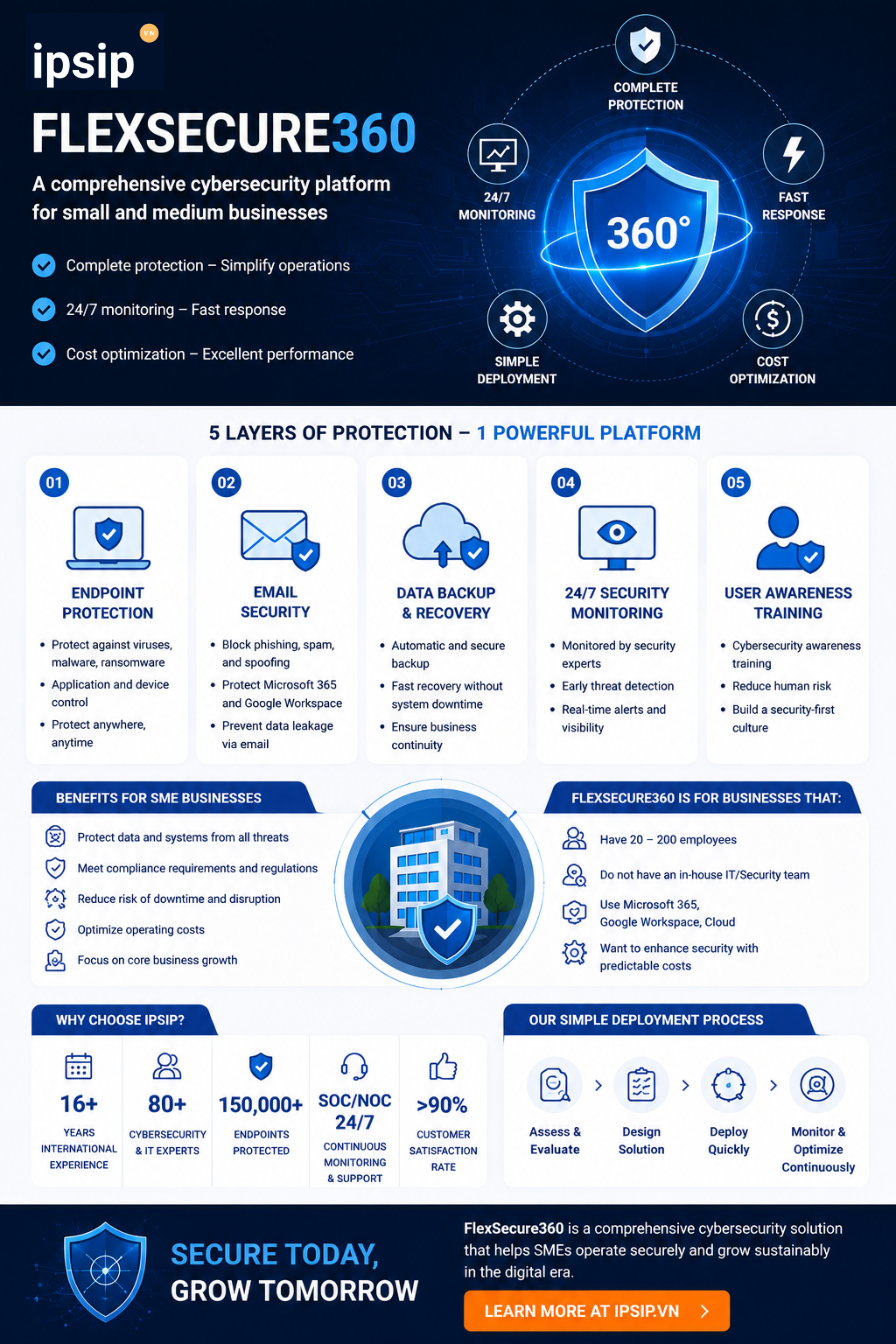
Designed flexibly for scales of 20 to 200 users under a Software-as-a-Service (SaaS) model, FlexSecure360 - an exclusive solution from IPSIP Vietnam - delivers core benefits that directly resolve business pain points:
Compliance with international standards and Vietnamese laws: The system is engineered to meet the most stringent benchmarks like ISO/IEC 27001 and GDPR, thereby directly empowering businesses to fulfill the strict requirements of the Personal Data Protection Law 2025 regarding controlling, monitoring, and protecting customer data.
A robust shield against malware and data leaks: Boasting a 99% threat detection rate (blocking 479 out of 486 simulated attacks), this solution integrates Endpoint Security and Email Security to completely eliminate Phishing and Ransomware before they can access sensitive corporate data.
24/7 monitoring and incident response replacing internal teams: Operating under a Managed Service Provider (MSP) model, your entire business traffic is continuously monitored by high-level security engineers. If any attack indicators arise, the system automatically triggers real-time alerts, perfectly aligning with Decree 356's "72-hour incident detection and reporting" mandate.
Flexible OPEX transformation: Smart pay-as-you-go pricing based on actual user counts completely removes the heavy "hidden costs" associated with maintaining physical servers or training specialized cybersecurity staff.
The year 2026 marks a crucial turning point for small businesses. Information technology is no longer just an operational support tool; it has become the core foundation protecting your revenue, customers, data, and brand reputation. A business can delay IT investments for a short while, but it cannot delay the consequences when an incident occurs. Building a modern tech infrastructure combined with security solutions like FlexSecure360 is a vital step to mitigate risks, enhance compliance, and establish a solid foundation for sustainable growth in the coming years.
-------
References
Personal Data Protection Law No. 91/2025/QH15: https://thuvienphapluat.vn/van-ban/Bo-may-hanh-chinh/Luat-Bao-ve-du-lieu-ca-nhan-2025-so-91-2025-QH15-625628.aspx
Decree 356/2025/ND-CP guiding the implementation of the Personal Data Protection Law: https://thuvienphapluat.vn/van-ban/Quyen-dan-su/Nghi-dinh-356-2025-ND-CP-huong-dan-Luat-Bao-ve-du-lieu-ca-nhan-687428.aspx
Zoom Small Business Technology Trends Report: https://www.zoom.com/en/blog/small-business-tech-trends/
Microsoft Security Report


