
HOT: NIST releases ransomware risk management 2026

In June 2026, NIST officially published NIST IR 8374r1 – Ransomware Risk Management: A Cybersecurity Framework 2.0 Community Profile, an updated version that supersedes the 2022 publication.
The document helps organizations assess ransomware readiness, prioritize risk reduction measures, and build response and recovery processes based on Cybersecurity Framework (CSF) 2.0.
Why is this document worth reading?
In recent years, ransomware has evolved from a purely technical issue into a serious operational risk for businesses. As a result, many organizations are shifting from a “respond after the incident” mindset to building prevention, resilience, and recovery capabilities in advance.
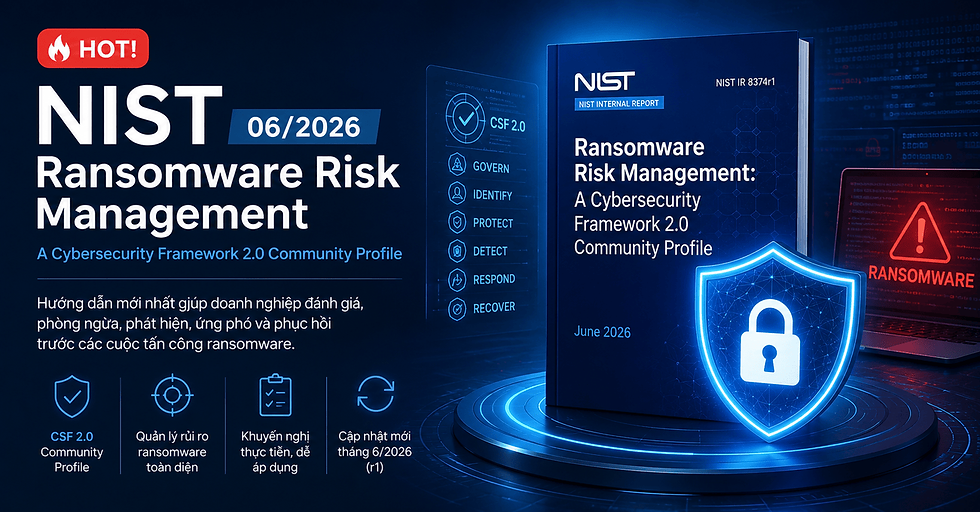
NIST IR 8374r1 reflects this shift. Instead of presenting isolated technical controls, the document organizes ransomware risk management around the six functions of NIST CSF 2.0: Govern, Identify, Protect, Detect, Respond, and Recover. This makes it more practical than a simple cybersecurity checklist.
It is not only about preventing ransomware
The value of this document does not come from introducing a new technology.
NIST focuses on how organizations can build a structured risk management approach to reduce the impact of ransomware incidents.
Key topics include:
identifying critical assets;
managing vulnerabilities;
improving cybersecurity awareness;
developing incident response plans;
testing data recovery capabilities;
integrating ransomware risk into enterprise risk management.
This makes the document relevant not only for technical teams, but also for IT managers, risk leaders, and business executives.
What is new in the June 2026 version?
Compared with the 2022 version, the new release has been updated to align with Cybersecurity Framework 2.0 and introduces a dedicated Community Profile for ransomware.
Notable updates include:
alignment with CSF 2.0;
guidance for assessing organizational readiness;
a prioritized set of ransomware risk management outcomes;
references to additional NIST resources for practical implementation.
Should organizations spend time reading it?
For organizations already using or evaluating NIST CSF, this is a document worth updating.
Even for organizations that have not yet adopted CSF, it provides a practical overview of how to structure ransomware risk management according to an internationally recognized framework, especially for small and mid-sized businesses building cybersecurity processes from the ground up.
IPSIP Expert Perspective
The most valuable point in this publication is not that NIST introduces more security tools. It is that NIST positions ransomware as part of enterprise risk management under CSF 2.0.
This shows that ransomware readiness is no longer only an IT responsibility. It must be connected to governance, operations, business continuity, and recovery planning.
What organizations can do internally
Inventory all IT assets.
Review unpatched systems.
Enable multi-factor authentication.
Apply the 3-2-1 backup rule and test restoration.
Build ransomware incident response scenarios.
Conduct regular ransomware tabletop exercises.
Apply Zero Trust and least privilege principles.
Professional support from IPSIP
For organizations with complex infrastructure or continuous monitoring requirements, relying only on internal processes may not be enough. IPSIP recommends combining a Security Operations Center (SOC) to detect and respond to early signs of attack with Vulnerability Assessment to reduce weaknesses that ransomware actors may exploit.
Download the official NIST document
The original document is 23 pages long and available free of charge from NIST.
For organizations that want to review the full recommendations and compare the Ransomware Community Profile against their current cybersecurity posture, the official publication is a useful reference to keep and share with IT, security, and risk management teams.
----------------------------
🤝 IPSIP Referral Partner Program

A Simple Partnership Process
1. Refer a potential clientShare the contact information of organizations that may benefit from IPSIP's cybersecurity services.
2. IPSIP provides consultationOur cybersecurity specialists will contact the client, assess their requirements, and recommend the most suitable solution.
3. Solution agreement & project deliveryIPSIP works directly with the client to finalize the scope and deliver the agreed cybersecurity services.
4. Receive your referral commissionOnce the project is successfully completed in accordance with the agreement, the referral partner receives the corresponding commission.
IPSIP maintains a transparent referral tracking process and commission policy, ensuring long-term trust and successful partnerships.
📩 Become an IPSIP Referral Partner
If you regularly work with organizations that require cybersecurity services or regulatory compliance support, join the IPSIP Referral Partner Program to deliver greater value to your clients while creating an additional source of revenue.
Register today to receive:
Competitive referral commission policies
Service brochures and sales materials
Technical support from IPSIP's cybersecurity experts
Assistance throughout the entire sales and project lifecycle
Grow your network, support your clients with trusted cybersecurity solutions, and earn rewards through a long-term partnership with IPSIP.


