
IT Checklist for Small Business: The Essential IT Checklist Every Business Needs in 2026

Running a small business without a dedicated IT team is becoming increasingly challenging. From cyber threats and cloud applications to employee devices and regulatory compliance, businesses must manage more technology than ever before.
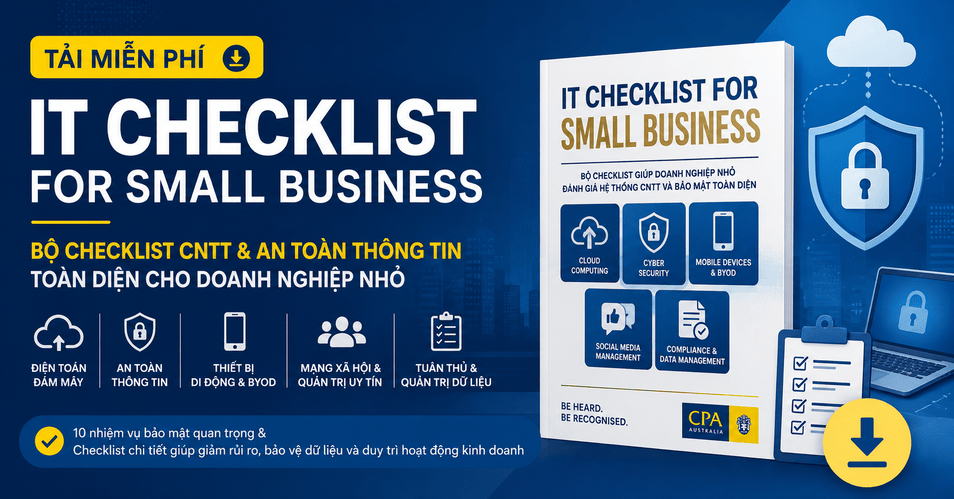
The IT Checklist for Small Business is a practical guide that helps organizations evaluate their IT infrastructure and cybersecurity posture using a comprehensive checklist covering 10 essential security tasks and dozens of real-world IT management best practices.
Whether you're looking to reduce cyber risks, protect sensitive data, or improve business continuity, this checklist provides a structured starting point.
About IPSIP Vietnam
IPSIP Vietnam is a trusted provider of cybersecurity solutions, managed IT services, and outsourced IT support for businesses across Vietnam.
Backed by more than 15 years of experience from IPSIP Group (France), we deliver comprehensive services including 24/7 SOC, 24/7 NOC, IT Helpdesk, Cloud Solutions, Firewall Management, and cybersecurity services tailored for small and medium-sized businesses.
Our mission is to make enterprise-grade cybersecurity accessible to Vietnamese businesses by helping organizations build secure, reliable, and cost-effective IT environments that support long-term digital transformation.

-------------------
What IT risks are small businesses facing in 2026?
Many small businesses continue operating without an internal IT department. Meanwhile, business data is spread across multiple platforms—including email, cloud storage, mobile devices, collaboration tools, and various online applications.
It only takes a single compromised password, a successful phishing email, or a lost company device for operations to be severely disrupted.
The IT Checklist for Small Business was designed to help organizations identify these hidden vulnerabilities before they turn into costly security incidents.
Why do small businesses overlook critical security gaps?
Most small businesses naturally prioritize sales, customer service, and day-to-day operations. As a result, IT management and cybersecurity reviews are often postponed until a problem occurs.
Questions such as these frequently go unanswered:
Is business data backed up every day?
Who currently has access to critical systems?
Are employees storing company data on personal devices?
Have all systems received the latest security patches?
Does the business have a disaster recovery plan?
Unfortunately, many organizations don't evaluate these areas until after a cyberattack, data loss, or system failure has already occurred.
How does the IT checklist for small business help?
The greatest value of this guide is its structured framework for evaluating the most important aspects of IT management and cybersecurity.
The checklist focuses on five key areas:
Cloud Computing
Social Media & Online Reputation Management
Mobile Devices & BYOD (Bring Your Own Device)
Information Security & Cybersecurity
Regulatory Compliance & Data Governance
Beyond high-level recommendations, the guide also provides detailed checklists that help businesses assess their current IT environment, identify security gaps, and prioritize improvements based on their operational needs.
Who should download this IT checklist?
This guide is designed for organizations that want to strengthen their IT operations and cybersecurity without unnecessary complexity. It is especially valuable for:
Small and medium-sized businesses (SMBs)
Business owners without a dedicated IT department
Office managers responsible for IT administration
Internal IT teams looking for a practical assessment framework
Companies preparing for digital transformation or cybersecurity compliance initiatives
Whether your organization has ten employees or several hundred, this checklist helps you identify security gaps before they become business risks.
What’s included in the IT checklist?
The guide contains a comprehensive collection of practical checklists covering the most critical aspects of business IT management.
Key topics include:
Cloud Computing
Evaluate cloud security settings
Review data backup and recovery strategies
Verify user access controls
Assess cloud service providers
Social Media
Protect business social media accounts
Enable multi-factor authentication (MFA)
Manage administrator permissions
Prevent account takeover attacks
Mobile Devices
Secure smartphones and tablets
Establish Bring Your Own Device (BYOD) policies
Encrypt company devices
Enable remote wipe capabilities
Information Security
Password management
Multi-factor authentication
Endpoint protection
Security awareness training
Email security
Data backup
Patch management
Network security
Regulatory Compliance
Data protection practices
Privacy requirements
Access control policies
Documentation and security procedures
Instead of focusing only on technology, the checklist also emphasizes people, processes, and governance—helping businesses build a stronger overall security posture.
Top 10 information security tasks every small business should complete
The guide highlights ten essential cybersecurity practices that every business should implement:
Create regular data backups.
Enable Multi-Factor Authentication (MFA).
Keep operating systems and software up to date.
Use strong password policies.
Install and maintain endpoint protection.
Secure Wi-Fi and business networks.
Limit user access based on business roles.
Train employees to recognize phishing attacks.
Develop an incident response plan.
Review and update cybersecurity policies regularly.
These foundational controls significantly reduce the likelihood of ransomware, phishing, credential theft, and other common cyberattacks.
Why this checklist matters more than ever in 2026
Cybersecurity is no longer a concern only for large enterprises.
Small businesses are increasingly targeted because attackers know they often lack dedicated IT staff, formal security processes, and continuous monitoring.
At the same time, businesses are adopting more cloud services, remote work, AI-powered tools, and connected devices, expanding the overall attack surface.
A simple checklist can help organizations:
Identify hidden IT vulnerabilities
Improve operational resilience
Reduce cybersecurity risks
Strengthen compliance readiness
Prioritize IT investments more effectively
Rather than reacting after an incident occurs, businesses can proactively improve their security posture through regular assessments and continuous improvement.
Download the IT Checklist for small business
A secure business starts with understanding where your risks exist.
Download the IT Checklist for Small Business to evaluate your current IT environment, identify improvement opportunities, and build a stronger cybersecurity foundation for your organization.
If you need professional assistance, IPSIP Vietnam also provides:
Managed IT Services
Cybersecurity Consulting
Vulnerability Assessment & Penetration Testing
Security Operations Center (SOC) Services
Cloud Security Solutions
24/7 IT Helpdesk & Infrastructure Support
Our experts are ready to help your business build a secure, reliable, and future-ready IT environment.


