
Core differences between penetration testing and vulnerability scanning

An enterprise's defense system cannot be optimized by relying on a single methodology against today’s sophisticated cyber threats. Understanding the true nature of each solution not only assists cybersecurity engineers in their daily operations but also empowers businesses to select the right security assessment framework.
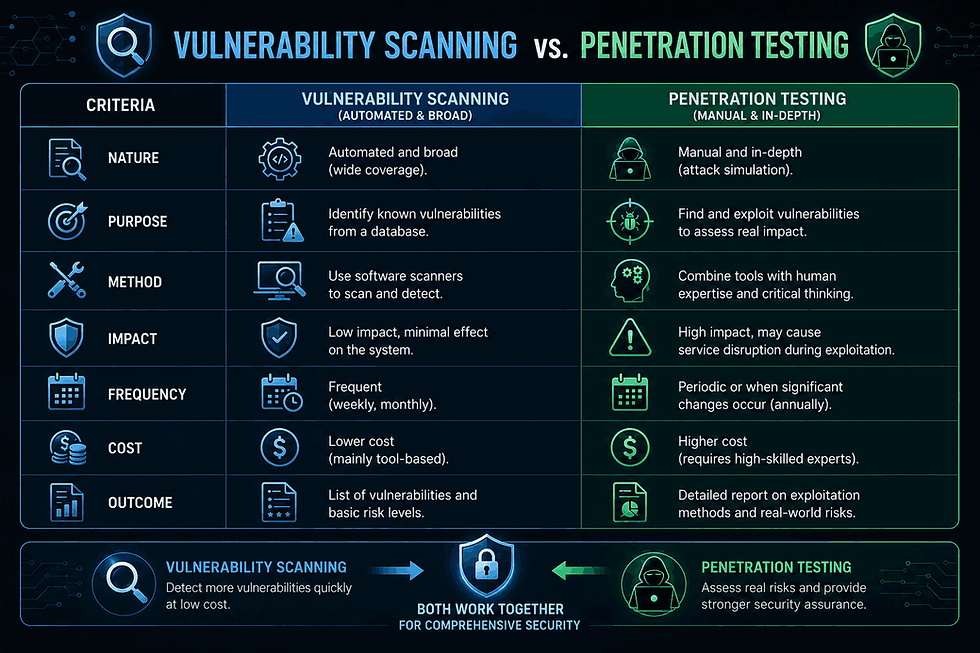
How do automated security scanning and penetration testing fundamentally differ?
1. Vulnerability scanning
Mechanism: Automated tools scan your systems, comparing software versions and configurations against global databases of known vulnerabilities (such as CVEs).
Pros: Fast, cost-effective, helps maintain basic "cyber hygiene," and ensures the network is free from common, legacy flaws.
Cons: Frequently generates high rates of false positives, fails to understand complex business logic, and cannot "think" to uncover Zero-day vulnerabilities or chained exploits of minor flaws.
2. Penetration testing
Mechanism: after identifying potential vulnerabilities, human ethical hackers actively attempt to exploit them to determine if they can breach sensitive data or gain unauthorized administrative control.
Pros: accurately assesses real-world risks. Security experts can chain multiple low-risk vulnerabilities together to execute a major exploit - something automated scanners can never achieve.
Cons: Time-consuming, capital-intensive, and requires close coordination with the enterprise's IT team to prevent accidental system downtime during active testing.

What is the crucial factor in enterprise vulnerability assessment?
The core difference in vulnerability assessment lies in the objective: cataloging known weaknesses versus proving control effectiveness and actual impact when those weaknesses are weaponized. Standard scanning provides a long list of potential flaws, which is often riddled with alert fatigue.
A deeper pen testing analysis dissects the operational context of the source code to determine whether a vulnerability can actually be leveraged to compromise core databases. This eliminates noise and allows organizations to prioritize remediation resources on their most critical information assets.
How to determine the right cybersecurity audit depth for your infrastructure?
The depth of a cybersecurity audit is dictated by data sensitivity, infrastructure scale, and industry-specific regulatory compliance. To clearly understand how automated tools and manual pen testing services compare in scope and cost, refer to the matrix below:

Where does the value of manual Penetration testing?
Every IT infrastructure possesses a unique architecture. This is why attack scenarios must be custom-tailored to the specific functional and technical design of each target. This specialized approach allows organizations to:
Identify and remediate hidden security blind spots and complex logic flaws.
Safeguard sensitive data and critical digital assets from exposure.
Ensure business continuity by mitigating the risk of unexpected downtime.
Maintain and strengthen trust with clients, partners, and stakeholders.
Evaluate resilience against real-world, sophisticated cyber attacks.
Achieve compliance with global security standards and regulations (GDPR, PCI DSS, etc.)
Why choose Penetration testing solutions from IPSIP Vietnam?
Simulating advanced cyberattacks and conducting deep security assessments requires profound technical expertise to avoid disrupting live production environments. This makes IPSIP Vietnam the ideal strategic partner to help enterprises accurately measure their defense capabilities while ensuring absolute compliance with the Cybersecurity Law 2025.

IPSIP's ecosystem leverages a powerhouse team of over 80 senior experts holding prestigious global certifications (including AWS Certified Architects and WALLIX Privileged Access Management - PAM administrators). Backed by a 24/7 Network Operations Center (NOC) and 24/7 Security Operations Center (SOC), every vulnerability discovered during testing is delivered with a root-cause remediation roadmap. Establishing a robust Zero-Trust architecture post-assessment completely neutralizes future threat vectors.


