
Alarm: AI behind nearly half of cyberattacks in Vietnam

In the first half of 2026, Vietnam's information security landscape recorded a concerning shift as artificial intelligence (AI) began directly participating in intrusion and data theft activities. In light of millions of personal data records being put up for sale, strengthening defenses and tightening legal frameworks have become top priorities.
Surge in AI-powered cyberattacks
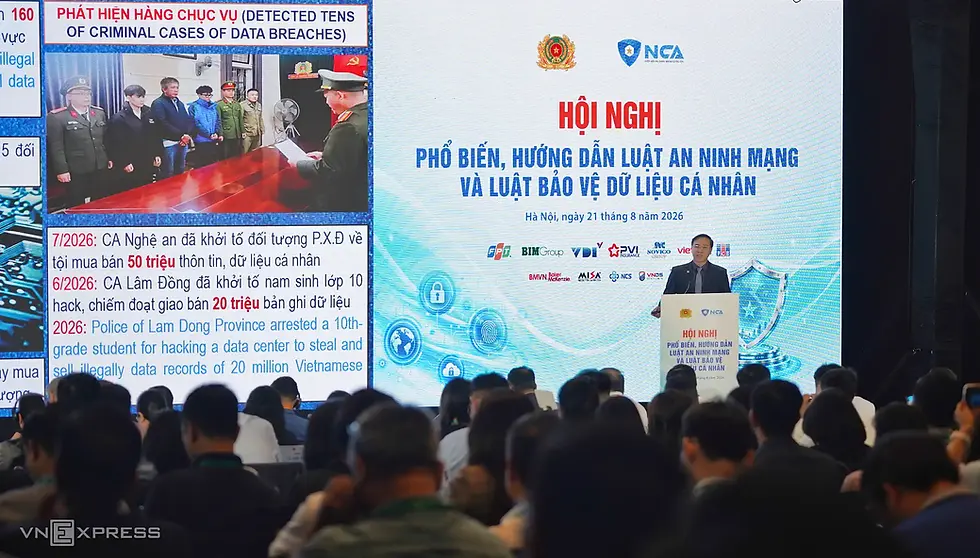
Information from a recent cybersecurity law awareness conference revealed that VNCERT's monitoring system recorded approximately two million cyberattack alerts in just the first six months of 2026. Among these, nearly 50% involved AI intervention to automate vulnerability scanning, malware distribution, and system intrusion.
Senior Lieutenant Colonel Nguyen Dinh Do Thi, Deputy Head of Division 1, Department of Cybersecurity and High-Tech Crime Prevention (A05 - Ministry of Public Security), noted that AI technology has driven the speed and scale of attacks to unprecedented levels, posing major obstacles to detection and incident response efforts.
This is also a growing global concern. A July report from US cybersecurity firm Sysdig revealed the emergence of AI agents capable of operating ransomware autonomously without human intervention. They can steal credentials, penetrate deeply into systems, encrypt, and wipe out original enterprise databases before demanding ransom in cryptocurrency.
The reality of data trading and threats from connected devices
Alongside system attacks, the illegal trading of private information has become increasingly complex. In 2025 alone, authorities coordinated to address over 30 cases of illegal data appropriation and trading involving approximately 160 million leaked records, including bank account details and biometric data.
Notable cases include:
Thua Thien Hue (2025): Dismantled a data trading ring involving 56 million records.
Nghe An (July 2026): Prosecuted an individual for trading 50 million personal data records.
Lam Dong: Prosecuted a student for breaching systems to steal and sell 20 million data records.
Additionally, Internet-connected smart devices such as surveillance cameras, smart TVs, and smartphones have become prime targets. Threat actors exploit security vulnerabilities to hijack control and extract private footage or images for dissemination or extortion.
Personal data becoming "prime bait" for fraudsters

Leaked personal information serves as the primary input for criminals to craft sophisticated scam scenarios, impersonating police officers, bank representatives, insurance agents, teachers, doctors, or delivery personnel. Statistics from 2020 to 2025 indicate that authorities uncovered 24,000 online fraud cases with total stolen assets exceeding VND 40,000 billion.
This situation stems from two main factors:
User complacency: Individuals remain negligent, easily sharing personal identification documents or private details on social media.
Enterprise shortcomings: Many organizations fail to invest adequately in information security infrastructure and lack strict HR management, leading to employees leaking data prior to resignation.
Tightening the legal framework and the "5 No's" rule for users

To enforce order in cyberspace, two important laws have been finalized. The Law on Personal Data Protection took effect on January 1, 2026, while the Law on Cybersecurity took effect on July 1, 2026. The new regulations strictly prohibit any illegal processing, trading, leaking, or appropriation of data.
Penalties for non-compliance are clearly defined:
Data trading: Maximum fines up to 10 times the illegal revenue generated.
Illegal cross-border data transfer: Fines up to 5% of the total revenue from the preceding financial year in Vietnam.
Other violations: Fines up to VND 3 billion, alongside potential criminal prosecution and liability for civil damages.
To mitigate risks, A05 representatives advise businesses to review and classify data while conducting regular security awareness training for employees. For individuals, citizens are urged to remember the "5 No's" rule:
Do not share personal details or identification documents on social media.
Do not plug unknown storage devices into computers containing critical data.
Do not click unverified links or open unauthenticated file attachments.
Do not transfer money at the request of strangers.
Do not download applications or enter financial credentials without verifying the source.
Building a culture of data protection in the digital era
The recent cybersecurity law dissemination event, part of a series of activities marking Vietnam Cybersecurity Day, attracted nearly 800 delegates representing government agencies, organizations, research institutes, and the business community.
Speaking at the event, Major General Le Xuan Minh (Director General of A05) and Senior Lieutenant Colonel Nguyen Dinh Do Thi emphasized that data must be viewed as vital raw material and an invaluable asset. Personal data protection goes beyond legal compliance - it must become an integral part of corporate governance culture as well as an everyday habit for individuals.
IPSIP Vietnam: What should enterprises do against the wave of AI-driven attacks?
To respond to increasingly sophisticated AI attack vectors, IPSIP Vietnam recommends that enterprises move away from passive traditional security methods and proactively implement comprehensive solutions:
Deploy AI-powered defenses: Integrate automated monitoring and protection solutions (SOC/EDR) to detect and block malware in real time.

Audit infrastructure and ensure compliance: Audit IT infrastructure and strictly classify data in accordance with the Law on Personal Data Protection to avoid severe administrative fines.
Establish backup & Incident recovery protocols: Maintain regular Disaster Recovery routines to proactively withstand Ransomware threats.
Conduct Security Training: Organize simulated attack drills to heighten employee vigilance and mitigate insider account leak risks.
Making adequate investments in security infrastructure through partnership with trusted infrastructure and cybersecurity providers like IPSIP Vietnam is not only a matter of regulatory compliance, but also a core value that helps enterprises maintain customer trust in the digital age.

Source: VNExpress


