
Cybersecurity system for SMEs: Are more security tools really better?

A business may already have a firewall, anti-malware software, email security, data backup, device management, and several monitoring tools. On paper, this may appear to be a comprehensive cybersecurity system.
However, when an alert appears, the IT team may still need to log in to multiple dashboards, review data from different systems, export reports to spreadsheets, and contact several vendors just to determine what is happening.
This is a common cybersecurity paradox today: businesses own more tools, but they do not necessarily gain better visibility into risks or respond to incidents faster.
For SMEs with limited IT resources, an effective cybersecurity system for small and medium-sized businesses should not be measured by the number of products purchased. What matters more is whether the security layers work together, whether alerts are handled promptly, and whether the business has enough resources to operate the entire system effectively.
In 2026, businesses are not only facing more threats
On July 8, 2026, WinCap warned about “security tool sprawl,” a situation in which businesses accumulate too many security tools that are not connected to one another. The consequences may include overlapping functionality, inconsistent reporting, slower investigations, higher operating costs, and reduced visibility into overall risk.
The issue is becoming more serious as the corporate attack surface continues to expand. Email, Microsoft 365 accounts, remote-working devices, cloud applications, internal data, third-party vendors, and IoT devices can all become potential entry points.
Today’s major risks are no longer limited to viruses or attacks against internal networks. Ransomware, phishing and business email compromise, cloud data leaks, supply chain attacks, identity theft, insider risks, and AI abuse all require different layers of protection.
Businesses can also review IPSIP’s analysis of the seven cybersecurity threats businesses must address in 2026 to identify the risks that should be prioritized in their current security environment.
However, a growing number of threats does not mean businesses should continue buying a separate tool for every new risk. When each product operates independently, a larger security stack may become even more difficult to control.
Why having more security tools is still not enough
In June 2026, MSPGeek cited data showing that 93% of surveyed SMBs believed they understood cybersecurity risks, 83% said they had a cybersecurity plan, and 71% believed they could handle a serious incident. However, only 22% had achieved an advanced level of cybersecurity maturity.

This gap shows that “having a solution” or “having a plan” does not necessarily mean the business has real cyber resilience.
MSSP Alert also reported that incident rates were almost the same among SMBs with a cybersecurity plan and those without one. The report emphasized that small businesses need actionable guidance, simplicity, and practical support rather than more dashboards and alerts.
The problem usually comes from 4 major gaps.
1. Security tools do not share data
An email security platform may detect a suspicious message. An endpoint protection tool may identify an unusual process. A cloud platform may detect a login from an unfamiliar location.
If these three systems operate separately, the IT team may fail to recognize that they are different stages of the same attack.
Each tool sees part of the incident, but no single system provides enough context for the business to make an informed decision.
2. Too many alerts, but not enough prioritization
When each product uses a different method to classify alerts, the IT team must manually compare severity levels, affected assets, and required actions.
3. Overlapping features and costs
Security tool sprawl rarely appears overnight. It gradually develops as businesses purchase additional products for different projects, departments, or compliance requirements.
Over time, two or more platforms may provide similar functions but continue to be renewed because no individual or team is responsible for reviewing the entire cybersecurity architecture.
The real cost extends beyond software licensing. Businesses must also account for:
The time required to configure and monitor each tool
Employee training costs
Account and access-right management
Time spent working with multiple vendors
Effort required to consolidate reports and compliance evidence
The risk of misconfiguration or missed alerts
4. Technology exists, but no one operates It
Cybersecurity tools do not create an effective defense on their own. They still require people to monitor, analyze, and respond to alerts.
An IPSIP analysis reported that 57% of Vietnamese businesses referenced in the survey were experiencing a shortage of qualified cybersecurity professionals. This talent gap forces IT teams to divide their time across too many responsibilities, increasing the likelihood that critical risks will be overlooked.
7 signs that a business security system is becoming fragmented
There is no fixed number that determines whether a business is using too many security tools. The issue should be evaluated based on operational effectiveness and security outcomes.
Warning Sign | Impact on the Business |
Multiple dashboards are required to investigate one alert | Incident verification and response take longer |
Different departments produce conflicting reports | Management lacks a unified view of cybersecurity risk |
Several tools provide similar functions | Licensing and administration costs increase |
Alerts are frequently ignored | A real attack may be missed |
No clear owner is responsible for the issue | Incidents are passed between departments and vendors |
Compliance reports are prepared manually | Reporting takes longer, and controls are harder to verify |
Every new requirement leads to another purchase | The security architecture becomes increasingly complex |
When a business experiences several of these warning signs, the next step should not automatically be to purchase another security product. The organization should first review its existing environment, identify which tools are genuinely necessary, determine where capabilities overlap, and assess which security layers lack operational ownership.
This is also the core idea behind a streamlined cybersecurity shield that replaces complex systems: cybersecurity should improve control, not create an additional management burden.
What should a cybersecurity system for SMEs provide?
A cybersecurity system suitable for SMEs does not necessarily need every new technology on the market. It must address the right risks and match the business’s actual operational capacity.
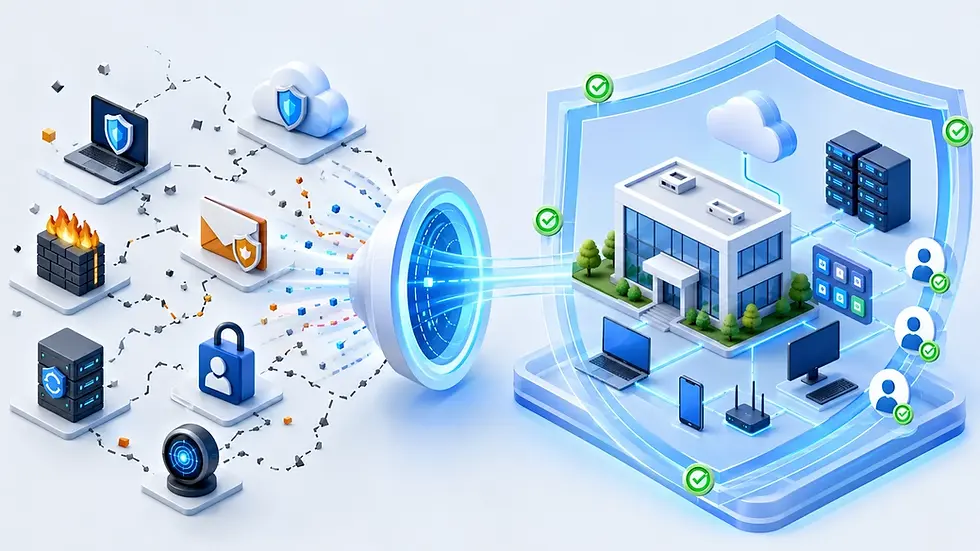
Before making another investment, businesses should ask 5 questions.
Do the security layers work together?Information from email, endpoints, accounts, networks, and cloud platforms should be placed in the same context to support investigations.
Can the business identify which alerts should be prioritized?The operations team must know which incidents affect critical assets and what action should be taken next.
Is someone responsible from detection through resolution?The business must clearly define who monitors, who investigates, and who responds when an incident occurs.
Can the organization continue using its existing infrastructure?Security consolidation does not mean replacing every previous investment. A new solution should be able to integrate with the current environment.
Can the system scale?When the business adds employees, opens a new office, or adopts more cloud services, the security system should support additional protection without requiring a complete redesign.
How FlexSecure360 helps businesses reduce security fragmentation
FlexSecure360 is a SaaS cybersecurity solution for SMEs. IPSIP positions it as a multi-layered defense model integrated through a unified platform.

The solution is not designed simply to add another cybersecurity tool. Its more important objective is to simplify how businesses deploy, manage, and scale their security environment.
According to IPSIP, FlexSecure360 can integrate multiple security capabilities, including Endpoint Security, Email Security, cybersecurity monitoring, data backup, vulnerability management, Security Awareness Training, and expert support. Businesses can select the modules that match their actual needs.
1. Reducing the number of disconnected solutions
Instead of independently purchasing and operating separate products, businesses can bring their key security layers into one coordinated deployment model.
This reduces the number of vendors and support processes the business must manage. It also allows internal IT teams to focus more on business operations instead of constantly switching between platforms.
2. Improving visibility and coordinated response
When security layers are deployed within a unified architecture, data from endpoints, email, networks, and cloud environments can be evaluated in the same context.
This gives businesses a stronger basis for distinguishing an isolated alert from a coordinated attack chain, allowing them to prioritize the correct incident and reduce investigation time.
3. Optimizing security spending based on actual needs
FlexSecure360 uses a modular model. Businesses do not need to purchase every capability at the beginning. They can select modules based on company size, number of users, device count, and risk exposure.
This approach helps prevent businesses from paying for unused capabilities while still allowing them to add new security layers as they grow.
4. Making use of existing infrastructure
FlexSecure360 can integrate with Microsoft 365, servers, endpoint devices, firewalls, and commonly used cloud platforms.
Businesses are not required to replace their entire existing environment. IPSIP can first assess which components should be retained, which should be integrated, and which security gaps still need to be addressed.
5. Addressing the cybersecurity skills gap
For SMEs without a dedicated cybersecurity team, the value of FlexSecure360 comes not only from the software but also from access to IPSIP’s cybersecurity specialists.
Businesses can reduce their dependence on a single IT employee who may already be responsible for the entire environment. When continuous monitoring and real-time response are required, FlexSecure360 can also be combined with IPSIP’s 24/7 SOC service.
6. Supporting business growth without adding more complexity
As a business adds employees, devices, or cloud environments, new modules can be added to the existing architecture.
This allows cybersecurity capabilities to scale alongside the business instead of requiring a new standalone product every time the organization changes.
Request a consultation for FlexSecure360 for small and medium-sized businesses. IPSIP can assess your current environment, identify overlapping capabilities, and recommend the security layers that best match your company’s size, risk profile, and budget.
Is your business managing too many security tools without having a unified view of risk?
Request a consultation for FlexSecure360 for small and medium-sized businesses. IPSIP can assess your current environment, identify overlapping capabilities, and recommend the security layers that best match your company’s size, risk profile, and budget
A proper assessment before further investment can help your business reduce complexity, optimize costs, and build a sustainable cybersecurity defense.
Where should businesses begin?
Before purchasing another security tool, businesses should conduct a short review of their current environment:
List all important assets, devices, accounts, applications, and data.
List all cybersecurity tools currently in use and their associated costs.
Identify overlapping features across products.
Determine which tools generate alerts that no one actively monitors.
Identify missing security layers.
Assess integration and data-sharing capabilities.
Assign clear responsibility to the person or provider handling incidents.
Businesses that are unsure where to begin can use IPSIP’s cybersecurity assessment service for businesses to obtain an independent view of their current environment before making additional investments.
A cybersecurity system for small and medium-sized businesses does not become stronger simply because it contains more tools.
When products operate independently, data becomes fragmented, and no one takes end-to-end operational responsibility, businesses may spend more while still facing blind spots, alert fatigue, and slow incident response.
SMEs do not need a longer list of technologies. They need a unified cybersecurity model with the right security layers, an appropriate level of investment, clear risk visibility, and access to expert support when required.
FlexSecure360 helps businesses move away from disconnected security tools and toward a multi-layered defense system that is more flexible and easier to manage. By integrating with existing infrastructure, offering modules based on actual needs, and combining technology with IPSIP’s operational expertise, the solution can reduce complexity while improving data protection and supporting business continuity.
-------------------
Frequently Asked Questions
How many cybersecurity tools are considered too many?
There is no fixed number. A business is using too many tools when management effort and costs continue to rise, but visibility, detection, and response capabilities do not improve accordingly.
Does FlexSecure360 require businesses to replace their entire existing system?
No. The solution is designed to integrate with Microsoft 365, servers, endpoints, firewalls, and common cloud platforms. The decision to retain, integrate, or replace a component depends on the results of the current-state assessment.
Does a business with an internal IT employee still need FlexSecure360?
Possibly. Internal IT employees are often responsible for user support, devices, networks, and business systems at the same time. FlexSecure360 can reduce the burden of managing multiple security tools and provide specialized cybersecurity capabilities that the internal team may not currently have.
--------------------
References
Too Many Tools, Too Little Control: The Hidden Cost of Fragmented Security: https://wincap.live/insights/blogs/too-many-cybersecurity-tools-security-fragmentation
The SMB Cybersecurity Gap: Why Having Tools Isn’t Enough: https://mspgeek.org/the-smb-cybersecurity-gap-why-having-tools-isnt-enough/
MSSP Alert – The SMB Cybersecurity Gap: High Awareness, Low Readiness: https://www.msspalert.com/news/the-smb-cybersecurity-gap-high-awareness-low-readiness


Comments