
IT Helpdesk for the fintech industry: Support speed goes hand in hand with access control

A fintech employee gets locked out of their account right before processing a transaction. The IT Helpdesk can quickly reset the password so the employee can resume working. But if the requester is not the account owner, an apparently simple support action could pave the way for unauthorized access.
That is why an IT Helpdesk in the fintech industry cannot be evaluated solely by ticket resolution speed. The service must also ensure identities are verified, access is controlled, technical actions can be traced, and security incidents are escalated promptly.
For banks, e-wallets, payment companies, and fintech enterprises, selecting the appropriate IT Helpdesk means balancing three elements: support speed, access control, and auditing capability.
Why does an IT Helpdesk in fintech require stricter control?
Standard IT Helpdesks receive and process computer, email, software, account, or network connection errors.

In the financial sector, many support requests also relate to trading application access accounts, accounting systems, customer data, or administrative privileges.
For example, the Helpdesk may have to handle:
Resetting passwords or Multi-Factor Authentication (MFA) methods.
Restoring access to business applications.
Supporting laptops capable of accessing sensitive data.
Granting temporary permissions for technicians to troubleshoot errors.
These actions carry different levels of risk. A printer error can be resolved following standard procedures, whereas a request to reset the MFA of an employee with transaction approval rights requires more thorough verification.
Therefore, a Helpdesk for fintech needs to categorize tickets by sensitivity level, not just by urgency. A request for rapid processing does not mean the Helpdesk is allowed to bypass verification or approval steps.
Grouping users to determine the scope of support
An effective banking or fintech Helpdesk model needs to clearly identify who is being supported, which systems they use, and what business operations they are authorized to perform.
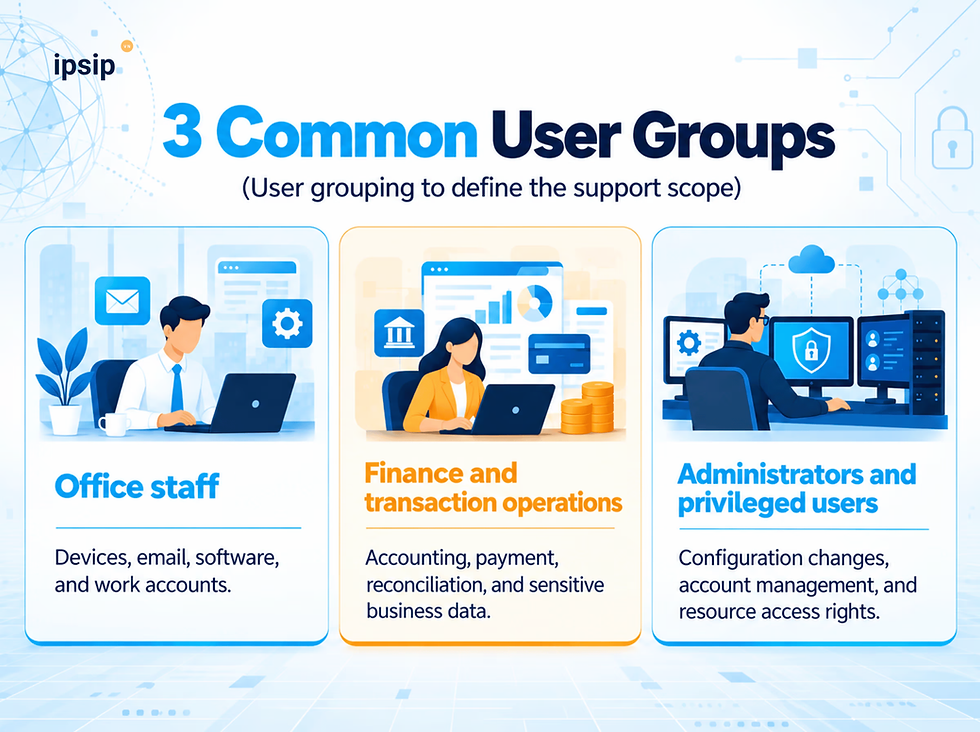
Office staff group: Typically requires support for devices, emails, software, and work accounts. The Helpdesk can handle the majority of requests according to standard procedures, but modifying authentication information still requires identity verification.
Finance and transaction operations group: May use accounting, payment, reconciliation applications, or sensitive business data. The Helpdesk should only perform actions within the authorized scope; changing business permissions requires approval from the system owner.
Administrators and privileged users group: Capable of changing configurations, managing accounts, or accessing multiple resources. Requests related to this group require separate verification, approval, and recording mechanisms.
Additionally, enterprises must define procedures for new hires, department transfers, employee offboarding, and partner accounts.
Grouping users is not meant to create extra bureaucracy. The goal is to help the Helpdesk determine which actions can be performed directly, which actions require approval, and which situations must be escalated.
Controlling privileged access when the Helpdesk processes tickets
Access management is a central requirement when deploying an IT Helpdesk for fintech, especially for actions like resetting MFA, granting application permissions, or using administrator accounts.
Verifying identity before recovering accounts
Suppose the Helpdesk receives a call from someone claiming to be a transaction office employee, reporting a lost phone and requesting an MFA reset.
If the technician relies solely on the full name, email, or employee ID, an attacker could exploit the gathered information to impersonate them.
A more secure process requires:
Receiving requests through a recognized support channel.
Verifying the requester using methods appropriate to the risk level.
Checking the authority to modify the account.
Performing the action after obtaining the necessary approvals.
Saving the ticket and notifying the result through an authenticated channel.
In cases of lost MFA devices, enterprises need to prepare a pre-approved identity recovery method, instead of letting technicians choose the verification method themselves.
Limiting the administrator privileges of technicians
Some endpoint or application support requests require administrative privileges. However, granting permanent administrator rights to the entire Helpdesk team can increase the impact level if a support account is compromised.
Enterprises should apply the Least Privilege principle, meaning technicians are only allowed to use the minimum necessary permissions.
For sensitive actions, permissions can be limited by system, task, and time. Privileged access rights must be approved, logged, and revoked upon completion.
If the enterprise uses Privileged Access Management (PAM), the Helpdesk process can be integrated with the privileged session management mechanism. However, PAM does not replace identity verification and the delineation of approval responsibilities.
What needs to be clarified when outsourcing the service is: what are the technicians allowed to do, who approves it, and how does the enterprise audit the actions?
Audit trail and endpoint: Supportable but must be traceable
In a financial environment, successfully closing a ticket does not mean the support process is complete. The enterprise also needs to determine who made the request, who approved it, and what changes were implemented.
What does an audit trail need to record?
For tickets related to accounts or access rights, the processing record should include the ticket ID, the requester's identity, verification results, the approver, the executing technician, the time of the action, and the final outcome.
For privileged actions, the enterprise may require linking the ticket with access logs or support session recordings.
Not all remote support sessions must be recorded. The method of preserving evidence, retention periods, and retrieval rights need to be determined based on the risk level, policies, and applicable legal obligations.
Protecting data during endpoint support
Laptops and workstations of fintech employees can access applications containing customer information or business data. Therefore, remote support requires using tools permitted by the enterprise, limiting the scope of actions, and controlling data transfer activities.
Technicians should not arbitrarily copy documents, capture sensitive information, or include passwords, authentication codes, and customer data in the ticket.
If an endpoint displays a malware warning, the Helpdesk must coordinate with the Security Team, avoiding arbitrary data deletion or device state changes that could affect the investigation.
In Vietnam, the Law on Personal Data Protection No. 91/2025/QH15, effective from January 1, 2026, creates an important legal foundation for personal data protection activities. Enterprises need to determine the responsibilities and corresponding protective measures when a Helpdesk provider accesses or processes personal data.
Criteria to evaluate when outsourcing an IT Helpdesk
Category | Proposed Control | Required Evidence |
User Groups | Grouping and limiting support scope | User group list |
Access | Identity verification, approval for permission changes | Approval record |
Privileged Access | Minimum privilege, time limits | Privileged session log |
Audit | Linking tickets with actual actions | Audit trail |
Endpoint | Controlled remote support | Support log |
Security Escalation | Clear escalation procedure | Escalation record |
BCP | Backup support channel and contact point | Procedure, drill results |
*This is a reference evaluation framework, not a mandatory control list universally applicable to all financial organizations.
The evaluation framework helps the IT, Security, and Procurement departments convert security requirements into testable criteria before signing a contract.
When must the Helpdesk escalate security incidents?
Not all support requests should be handled like standard IT errors.
An employee unable to log into their email might have just forgotten their password. But if the account exhibits unusual logins or unexpected MFA changes, the Helpdesk needs to consider escalating the request to the security assessment process.
Signs that require escalation criteria include:
Suspected account compromise.
Unusual MFA reset requests.
Endpoints triggering malware warnings.
Detection of unauthorized access rights changes.
Multiple users simultaneously losing access with unusual signs.
The Helpdesk must record initial information, preserve evidence within their scope of responsibility, and escalate the request to the Security team following a unified procedure.
NIST SP 800-61 Revision 3, published in April 2025, emphasizes integrating incident response into cybersecurity risk management. This demonstrates the necessity of a clear coordination and responsibility transfer mechanism between departments.
Enterprises also need to distinguish a Security Incident from a Major Incident. A Security Incident relates to information security risks, whereas a Major Incident is classified by its severe impact on business operations. An incident can belong to both groups.
Response, update, and escalation times must be reflected in the Service Level Agreement (SLA). Enterprises can refer to the article SLA IT Helpdesk: The foundation for uninterrupted operations to determine the appropriate metrics.
Maintaining the Helpdesk in BCP and selecting a provider
Business Continuity Planning (BCP) needs to account for the ability to maintain user support when ticketing, email, or Single Sign-On (SSO) systems experience an outage.
For IT support in fintech, the fallback support plan should identify alternative intake channels, the person responsible for coordination, identity verification methods, and how to record tickets for reconciliation after recovery.
Particularly, an interruption in the main authentication system does not mean the Helpdesk is allowed to bypass identity controls. Enterprises must design a pre-approved backup method.
For organizations with multiple offices or transaction points, the responsibilities for remote and onsite support must be clarified. The model of an IT Helpdesk for multi-branch enterprises is a reference direction when designing a single point of contact for requests across multiple locations.
6 issues to clarify before outsourcing the service
When comparing IT Helpdesk providers for fintech, enterprises should ask to clarify:
Service Scope: Which user groups, applications, and ticket types are within the support scope?
Access Control: What permissions is the provider granted? Who approves sensitive actions?
Audit: Can the enterprise retrieve tickets, logs, and execution evidence?
Security Escalation: Who receives the request when signs of intrusion or data leakage are detected?
SLA: How are intake, response, and escalation times measured?
BCP and transfer: How is the service maintained when systems are disrupted or the contract ends?
If an internal IT and Security team is already in place, the enterprise can consider a co-managed Helpdesk model. The provider assumes responsibility for receiving and handling requests within the authorized scope; the internal team maintains responsibility for sensitive approvals and security response decisions.

Choosing an IT Helpdesk by speed and control capability
An effective IT Helpdesk service for fintech not only helps employees recover their work quickly but must also accurately verify identities, limit access rights, and maintain traceability.
Before outsourcing the service, enterprises should simultaneously evaluate the support scope, privileged control, audit trail, endpoints, security escalation procedures, and operational continuity capabilities.
Choosing IT Helpdesk from IPSIP Vietnam
IPSIP offers IT Helpdesk & IT Support services for enterprises with a support scope determined by actual needs.

Fintech enterprises can contact IPSIP to survey their needs and receive an IT Helpdesk quote, clarifying user groups, SLA requirements, operational scope, and the control conditions to be included in the service plan.
References:
Vietnam Government Portal – Law on Personal Data Protection No. 91/2025/QH15
NIST SP 800-61 Revision 3 – Incident Response Recommendations and Considerations for Cybersecurity Risk Management


