The OpenAI invitation trap: A sophisticated tactic bypassing security systems

As artificial intelligence (AI) tools become indispensable in daily workflows, threat actors have devised a highly sophisticated new attack vector. By exploiting OpenAI's legitimate organization invitation feature, they are creating fake corporate workspaces to covertly harvest sensitive prompts, API activity logs, and critical proprietary data.
Legitimate invitations with a hidden trap
According to research by cybersecurity firm Push Security, attackers set up a rogue organization on OpenAI and name it after the target business (e.g., "Push Security Inc"). They then dispatch invitation links to the company's employees.
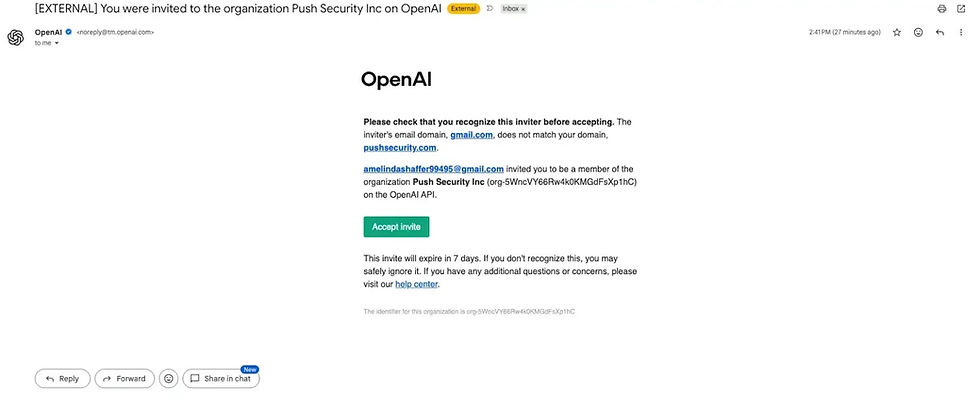
Crucially, these are not typical spam or spoofed emails. They originate directly from OpenAI's legitimate notification system (via the noreply@tm.openai.com). Consequently, these messages seamlessly bypass email security gateways and look exactly like a standard collaboration invite.
The only anomaly users might spot is a small disclaimer stating that the inviter's domain does not match the recipient's corporate domain. However, this minor detail is easily overlooked because the rest of the email appears entirely authentic and contains the actual company name.
A seamless and insidious trap mechanism
Once users click the link in the email, they fall into the trap immediately and unwittingly. Researchers noted that joining the rogue organization requires just a single click, completely bypassing any further verification or multi-factor authentication steps. Even if a user opens the link in an entirely new browser session where they have never logged in before, their account is instantly linked to the hacker-controlled workspace.
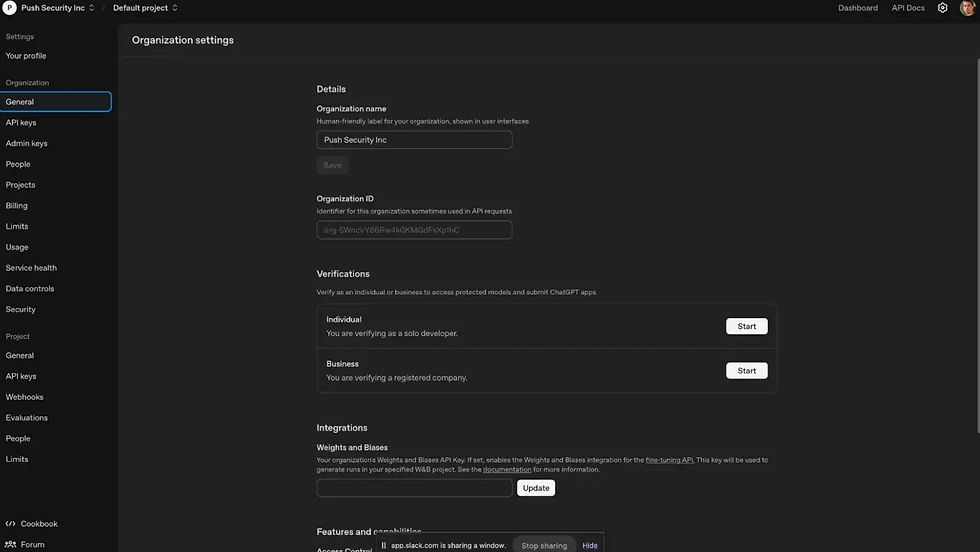
To boost credibility, attackers impersonate senior company executives and grant the highest administrative privileges (Owner) to all invitees. They even attach a pre-linked credit card to the account to dispel any suspicion should employees decide to use premium, paid features.
The silent objective: Long-term data harvesting
This tactic does not aim for immediate credential or password theft. Instead, hackers aim to "lay low" to establish long-term persistence for data exploitation. If employees believe this is the company's official workspace and use it, every prompt entered, file uploaded, or API transaction history falls under the attackers' control. This data can range from source code and internal documentation to security research and sensitive customer information.
This method is an evolution of rogue workspace attacks, which were flagged back in 2023 across standard SaaS environments. Today, with AI platforms operating as enterprise productivity hubs, the value of stolen prompt data is higher than ever.
Push Security warns that within this compromised workspace, attackers can escalate risks by sharing malicious conversations, injecting malicious prompts, or abusing third-party integrations. This paves the way for data exfiltration, OAuth token abuse, and lateral movement into other connected corporate services such as email, cloud storage, or team collaboration tools.
New challenges in advanced defense
This attack vector aligns with a broader trend of weaponizing trusted SaaS (Software-as-a-Service) platforms. Recent reports from Kaspersky and Cisco Talos highlight similar vulnerabilities being exploited across OpenAI, GitHub, and Jira, where threat actors embed malicious content directly into automated system notifications.
Thwarting this technique poses a significant challenge for traditional security solutions, as no malicious links or spoofed domains are involved; the entire underlying infrastructure is completely legitimate.
To protect themselves, organizations must:
Enhance visibility and monitoring into corporate SaaS application usage.
Strictly control and audit the external workspaces that employees join.
Conduct security awareness training to educate personnel that even official notifications from major platforms can carry security risks.
This incident exposes a widening security gap as SaaS and AI ecosystems rapidly expand. Collaboration features designed for convenience are being turned into entry points for malicious actors. Without more stringent controls from service providers - such as mandatory domain verification or restrictions on joining external organizations - businesses will continue to face the threat of silent core data exfiltration.