
VPS or Cloud Server: which is the optimal choice for businesses?

Choosing between a VPS or Cloud Server is a critical infrastructure decision that directly impacts the operational performance and data security of any business in the digital age. To optimize costs and ensure continuous system uptime, businesses must clearly distinguish between the fixed resource allocation of a VPS and the independent, flexible scalability of a Cloud Server.
According to infrastructure performance reports, more than 65% of small and medium-sized enterprises (SMEs) have faced severe website crashes or service disruptions due to choosing the wrong hosting platform. The surge in sudden traffic spikes during peak business campaigns has become a fatal challenge for legacy virtual private servers, causing an average revenue loss of 10% to 25% for online businesses after just a few hours of downtime.

Why can't traditional VPS handle sudden traffic spikes?
The core nature of a traditional Virtual Private Server (VPS) relies on hardware virtualization technology (such as VMware or KVM) to split a single physical server into multiple isolated virtual machines. Although hardware resources like RAM and CPU are allocated statically to each service package, the underlying system still shares critical core components of a single physical hardware unit, particularly network bandwidth and disk Input/Output (I/O).
When one or more neighboring VPS accounts on the same physical server (node) experience a sudden surge in traffic, a "noisy neighbor" bottleneck immediately occurs. The physical hardware becomes overloaded, causing a drastic drop in performance for all other VPS accounts on that same node, resulting in delayed response times or total system crashes—even if the traffic to your own website remains completely normal. The greatest strategic risk of a traditional VPS is its lack of an automated failover mechanism; if the physical server encounters hardware failures such as motherboard or power supply issues, all hosted VPS accounts go offline (downtime) until technicians physically replace the broken hardware.
How does a Cloud Server solve the "independent resource" challenge?
A Cloud Server completely eliminates the vulnerabilities of a traditional VPS by operating across a network of interconnected physical servers (a Cloud Cluster) combined with a centralized storage area network (SAN/Ceph Storage). All configured resources, including CPU, RAM, and storage space, are 100% independently dedicated to each customer, entirely removing the risk of resource contention caused by third-party workloads.
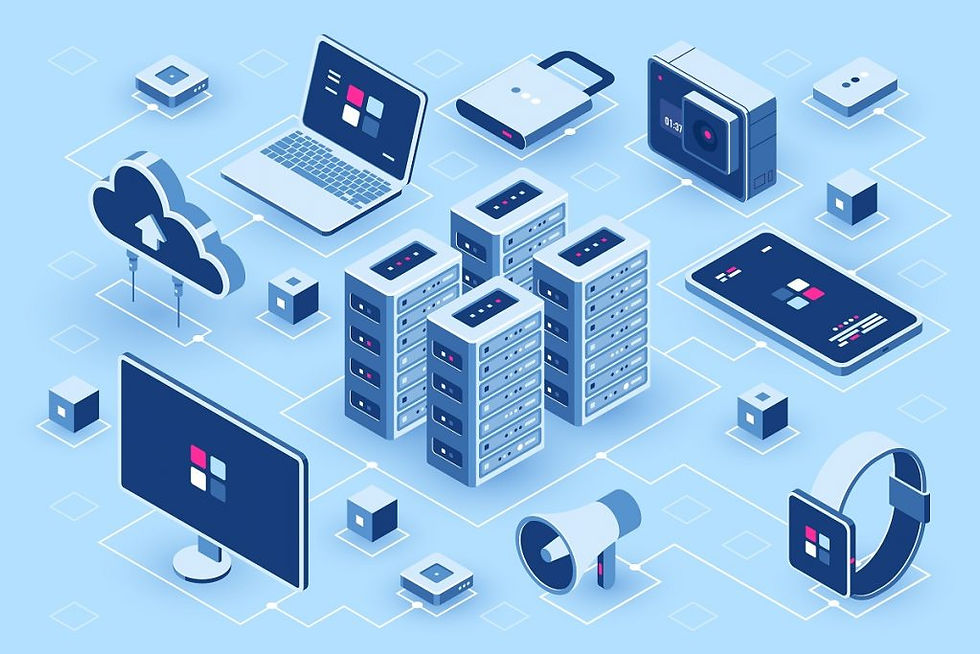
The biggest advantage of a Cloud Server lies in its fault tolerance and auto-scaling capabilities. If a physical server within the cloud cluster encounters an error, the system instantly triggers a live migration, moving your Cloud Server to another healthy node in the cluster without causing any service interruption. Furthermore, when traffic spikes occur, businesses can upgrade bandwidth, RAM, or CPU resources with just a few clicks or through automated policies, ensuring smooth system operations without needing to power down the server for hardware reconfigurations like a traditional VPS.
For a direct visual comparison, businesses can refer to the technical matrix below:
Technical Criteria | Virtual Private Server (VPS) | Cloud Server |
Infrastructure Architecture | Runs on a single, isolated physical server | Runs on an interconnected cluster of multiple servers |
Resource Guarantee | Virtualized resources; prone to "noisy neighbor" impacts | 100% actual dedicated resources; completely isolated |
High Availability (Uptime) | Dependent entirely on the durability of 1 hardware unit | Achieves 99.99% uptime via automated Failover |
Scalability | Limited to the hardware capacity of the host server | Instant, flexible scalability with no resource ceilings |
Storage Architecture | Local physical hard drives (Local Storage) | Advanced centralized network storage (SAN/Ceph) |
What makes the powerful and stable Cloud infrastructure from IPSIP Vietnam stand out?
If your business is looking for an optimal infrastructure solution to replace an unstable traditional VPS system, IPSIP Vietnam's Cloud Server service provides the ultimate strategic answer. IPSIP's cloud server infrastructure is specifically engineered to deliver 100% actual resources, ensuring maximum data processing performance and completely isolating your operations from network congestion risks in other partitions.
Cloud Servers from IPSIP integrate next-generation distributed storage technologies combined with enterprise-grade SSD/NVMe drives, delivering superior data read/write speeds and real-time resource scalability. The intelligent (N+1) redundancy mechanism implemented at our international standard data centers eliminates single points of failure, ensuring your business applications, websites, and core data remain online 24/7/365, even during peak market demand.

Why should businesses choose solutions from IPSIP Vietnam?
Extensive International Expertise: Leveraging profound technical expertise with over 15 years of experience in IT and telecommunications across France and European markets.
Highest Security Standards: IPSIP's entire operational infrastructure and service management workflows strictly comply with rigorous international standards, holding ISO 27001:2022 (Information Security Management System) and SOC 2 Type II audit certifications.
24/7 Deep Monitoring: Our team of cybersecurity engineers and systems experts continuously monitors the network infrastructure round-the-clock, detecting and mitigating potential cyber threats or performance anomalies long before they impact your business operations.
For businesses looking to optimize infrastructure costs and upgrade to an international-standard Cloud Server system, please discover more details at our official website: ipsip.vn.
Conclusion
The choice between renting a VPS or a Cloud Server heavily depends on your business growth strategy and data availability requirements. For online business systems and core applications that demand absolute stability and seamless scalability, investing in a Cloud Server is the foundational strategy to eliminate operational downtime risks and optimize long-term total cost of ownership (TCO).
References:


